Review
Teeter Power10 Rower Review
An elliptical path, resistance in both directions, and the widest published height range of any machine we track. It is also 181.8 lb and it does not teach you to row.
We earn a commission if you buy through the links on this page, at no cost to you. It has no effect on what we recommend or the order we recommend it in — we say “skip this one” on machines that pay us the same as the ones we like. How we’re funded.
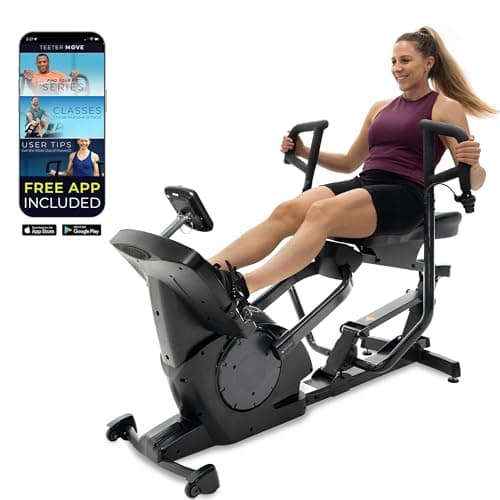
Teeter Power10 Elliptical Rower
Not really a rowing machine: an elliptical-path trainer with resistance in both directions, which fits a 7 ft user in 62.8 inches of floor where a Concept2 needs 96.
Skip this one if: Skip it if you want to row - the motion, the monitor and the metrics are all a different sport. Buy it as a low-impact full-body trainer or not at all.
Price as of November 12, 2026. #ad How we’re funded
Teeter is not a rowing company. It has spent forty years selling inversion tables, and the Power10 is what happens when a joint-friendly-equipment brand designs a full-body cardio machine from scratch instead of copying a boat. The seat does not run along a long rail. It travels an elliptical path on a wheel-and-fork arrangement, and the magnetic resistance loads the handle in both directions — so you can push away from yourself as well as pull, and switch between the two mid-session.
That design buys two things no conventional rower on this site offers. The machine is 62.8 inches long in use, against 96 inches for a Concept2 RowErg, and it still publishes a user height range of 4 ft 8 in to 7 ft 0 in — the widest published fit figure in our entire registry, achieved without a long rail because the path does the work instead. If the reason you have not bought a rower is that eight feet of floor is eight feet you do not have, this machine is the most interesting thing in the category.
It also costs you the rowing stroke, and we are going to be blunt about that below, because it is the single most important thing a buyer searching “Teeter Power10 rower” needs to understand. We have not used this machine. There is no test lab here and nobody writing this holds a coaching qualification — what follows is an assessment of the figures Teeter publishes on its own product page and on its Amazon listing, both read on 27 October 2026, and of the gaps those pages leave.
The published numbers
Specifications, and the gaps
Every row below is either a figure the manufacturer publishes or the words “Not published”. We do not estimate, and we do not fill a gap with a number from a review site.
| Specification | Teeter Power10 Elliptical Rower |
|---|---|
| Resistance | magnetic |
| Length | 62.8 in |
| Width | 37.5 in |
| Height | 43.3 in |
| Floor space you actually need | 6.2 ft x 5.1 ft (about 32 sq ft)Our arithmetic, not a manufacturer figure: published length + 12 in for handle travel at the catch, published width + 24 in for elbow room. |
| Machine weight | 181.8 lb |
| Maximum user weight | 300 lb |
| Maximum user height | 7 ft |
| Seat height | Not published |
| Rail length | Not published |
| Monitor | 4.25" LCD with quick-key start/stop; 5.3 kHz HRM compatible, strap not included |
| Storage | Upright on transport wheels; 43.3 x 37.5 x 62.8 in stored |
| Mains power required | Not published |
| Warranty | 3-year structural, 1-year mechanical and electrical parts |
| Noise (decibels) | Not publishedNo manufacturer on this site publishes a decibel figure for any machine. We will not estimate one. |
| Subscription | NoneTeeter states the Teeter Move app carries no membership fee. |
Specifications read from Teeter’s published listing and cross-checked against the manufacturer’s own specification page, accessed 2026-10-27. Last verified July 24, 2026.
The thing it is not
A rowing stroke is a specific, learnable movement: legs, then back, then arms, on the drive; arms, then back, then legs, on the recovery. It is sequenced, it is measurable in watts and 500 m splits, and it is the same movement in a boat as on an erg. That is why the whole sport has standardized on one machine, and why the form guide is the most useful page on this site for most buyers.
The Power10 does not do that. The handle travels an elliptical path rather than a straight line, and the resistance pushes back when you extend as well as when you pull, which means the muscles working on the recovery are loaded rather than resting. Teeter describes exactly this as the point: bi-directional resistance, a patented elliptical path, and the ability to switch from a pull motion to a push motion mid-workout to target some muscles while others recover. As an exercise idea that is coherent and genuinely different.
But it is not rowing, so three consequences follow. Nothing you build on it transfers to a boat or to a 2k test — if that matters to you, the 2k benchmark and the on-water transfer question are the pages to read instead. The monitor reports time, calories, distance and pace on a 4.25-inch LCD, not drag factor, watts or a 500 m split, so you cannot compare a session on it to anybody else’s rowing anywhere. And a rowing workout written for an erg — intervals at a given split, a steady 5k — cannot be followed on it. Teeter supplies its own classes through the subscription-free Teeter Move app instead, which is the sensible answer to a problem of its own making.
What the footprint actually buys
This is the real argument for the machine. Teeter publishes a maximum non-use envelope of 62.8 x 37.5 x 43.3 inches and a stored size of 43.3 x 37.5 x 62.8 inches upright on transport wheels. So it is about five feet two of floor length against a Concept2’s eight feet, and Concept2 recommends nine feet by four with clearance to row.
The trade is width. At 37.5 inches the Power10 is half again as wide as almost everything else we track — a RowErg is 24 inches, a MERACH Q1S narrower still — because the elliptical mechanism needs the room the rail would have used. In a long narrow room that is a worse shape; in a square spare bedroom it is a better one. The arithmetic for working out which you have is in space requirements, and best compact rowing machines is where the conventional short-footprint options are ranked.
And then the weight: 181.8 lb. That is not a typographical error and it is not close to anything else on this site — the next heaviest machine we track is an Aviron at 114 lb, and a Concept2 RowErg is 57 lb and comes apart into two pieces. The Power10 does not come apart. It has transport wheels and it stores upright, both of which help, but getting 181.8 lb into position in the first place is a two-person job and taking it upstairs is a conversation rather than an afternoon. If the machine has to live on a first floor, read rowing machines for an upstairs room first.
The fit range is the best number on the page
Teeter publishes a usable height range of 4 ft 8 in to 7 ft 0 in. Both ends of that are remarkable. The upper end is the only published figure above 6 ft 7 in anywhere in our registry, which makes this the only machine we can point a genuinely tall buyer at on published data rather than on a rail measurement and a guess — see best rowing machines for tall users for how thin the published evidence is everywhere else. The lower end matters even more in practice, because a minimum fit figure is the single rarest spec in this category: almost no maker publishes one at all, which is the finding best rowing machines for teens is built on.
The capacity figure cuts the other way. Teeter publishes 300 lb, which is fine in isolation and modest in context: Concept2 publishes 500 lb, Aviron publishes 507 lb on the StrongGo, and several machines a quarter of this price publish 350 or 400 lb. A 7 ft user at 300 lb is a narrow window. If your figure is the weight rather than the height, the capacity ranking is the page you want.
Resistance, monitor and the parts you have to add
Seven magnetic levels on a 22.7 lb inertia-enhanced flywheel, selected by an easy-access lever you can reach mid-workout. Twenty-two pounds is a heavy flywheel by home-machine standards — the budget magnetic rowers we cover run 8 to 12 lb — and a heavier flywheel carries momentum between strokes, which is what makes a machine feel smooth rather than notchy. Seven levels is few, but on a bi-directional machine the levels are doing a different job than on a rail rower. How resistance levels actually work explains why the count on a spec sheet tells you less than the mechanism does.
The monitor is a 4.25-inch LCD with quick-key start and stop, and it is 5.3 kHz HRM compatible — a chest strap is not included, and 5.3 kHz is an analog standard rather than Bluetooth or ANT+, so a modern dual-band strap is not guaranteed to talk to it. Teeter’s Amazon listing separately describes the machine as Bluetooth HRM compatible, which is not the same claim. We cannot reconcile those two statements from published data, so if heart rate is the reason you are buying, ask Teeter which radio the console actually uses before you order. Machines that publish their heart-rate standards is the comparison page for that question.
The app is the genuinely good news: Teeter Move is stated to be subscription-free, with a class library included. On a $1,000-plus machine that is not a given — several connected rowers at this price are useless without a membership, and the five-year arithmetic is brutal. Our subscription comparison is where that difference shows up as money, and rowers that need no subscription is the wider field.
Warranty, and two things to check before you order
The standard warranty is 3 years structural and 1 year on mechanical and electrical parts. Teeter also offers a Double Extended Warranty on its own shop that takes those to 6 years and 2 years, listed at $59.00 with a current price of $49.00 when we read it. One year on the electronics of a machine with a console, a sensor and a magnetic brake is on the short side; three years on structure is respectable. For context, Concept2 publishes five years on the frame and two on parts as standard, with nothing to add on.
Two checks. First, the price. Teeter’s own shop listed the Power10 at $999.00, down from $1,099.00, on 27 October 2026, while the Amazon listing read $1,199.99 the same day. Buy wherever is cheaper when you look — we would rather tell you that than earn a commission on the dearer of the two, and the live figure on our buy button is read from the Amazon listing on the day you load the page. Second, the item number. Amazon’s listing carries item number XR1001 while Teeter’s current Power10 page carries XR2001. The published dimensions, weight, capacity, height range, resistance levels and flywheel are identical on both, so this looks like an item-number revision rather than a different machine — but we cannot confirm that from what either page publishes, and if it matters to you, ask which generation ships.
Who should actually buy it
Buy the Power10 if you want low-impact full-body cardio in a room that cannot take an eight-foot machine, you are taller or shorter than the usual fit range, and you do not care about rowing as a sport. On those terms it is a well-specified machine with an unusually heavy flywheel, a free app and a published fit range nobody else matches.
Do not buy it to row. If the appeal is the rowing stroke — the sequencing, the splits, the 2k, the carryover to a boat — buy a Concept2 RowErg and find the floor space, or take the honest compromise and buy a shorter conventional rower from best rowing machines for apartments. And if the real driver is joints rather than rowing, what low-impact actually means is worth ten minutes before you spend a thousand dollars. This is equipment selection and general information, not medical advice.
The number that decides it
What five years actually costs
Live machine price plus sixty months of whatever subscription the manufacturer requires. Prices update daily and expire on their own after 48 hours.
| Machine | Machine price | Subscription | Year 1 | Year 3 | Year 5 |
|---|---|---|---|---|---|
| Teeter Power10 Elliptical Rower | $1,200 | None | $1,200 | $1,200 | $1,200 |
Machine prices are live from Amazon as of November 12, 2026 and change without notice. Subscription figures are the published month-to-month rates, each cited on the subscriptions page. Totals are machine price plus the monthly rate multiplied by 12, 36 and 60. We do not model electricity, shipping, floor mats or resale value — each would need an assumption we cannot source, and adding them would make the number look more precise while making it less true.
Where to buy
If this is the one
Teeter Power10 Elliptical Rower
Price as of November 12, 2026. #ad How we’re funded
Straight answers
Questions people actually ask
Is the Teeter Power10 a real rowing machine?
Not in the sense most buyers mean. The seat travels an elliptical path rather than a straight rail, and the magnetic resistance loads the handle on the push as well as the pull - Teeter describes it as bi-directional resistance on a patented elliptical path. It is a full-body low-impact trainer that looks like a rower. Nothing you learn on it transfers to a boat or to a 2k erg test, and the monitor does not report watts, drag factor or a 500 m split.
How much space does the Teeter Power10 need?
Teeter publishes a maximum non-use envelope of 62.8 x 37.5 x 43.3 inches and a stored size of 43.3 x 37.5 x 62.8 inches upright on transport wheels. That is about five feet two of floor length against the eight feet a Concept2 RowErg occupies - but 37.5 inches of width, which is around half again as wide as a conventional rower, because the elliptical mechanism needs the room the rail would use.
How much does the Teeter Power10 weigh?
181.8 lb, published on Teeter's own product page. That makes it by a wide margin the heaviest machine we track - the next heaviest is an Aviron at 114 lb, and a Concept2 RowErg is 57 lb and separates into two pieces. The Power10 does not come apart. It has transport wheels and stores upright, but positioning it is a two-person job.
What height and weight is the Teeter Power10 rated for?
Teeter publishes a user height range of 4 ft 8 in to 7 ft 0 in - the widest published fit range of any machine in our registry, and one of very few that publish a minimum at all. The weight capacity is 300 lb, which is modest in context: Concept2 publishes 500 lb and several machines at a quarter of the price publish 350 or 400 lb.
Does the Teeter Power10 need a subscription?
No. Teeter states the Teeter Move app is subscription-free and includes a class library, which is unusual at this price - several connected rowers around $1,000 are close to useless without a paid membership. The console works standalone, showing time, calories, distance and pace on a 4.25-inch LCD.
What warranty does the Teeter Power10 come with?
Three years structural and one year on mechanical and electrical parts as standard. Teeter sells a Double Extended Warranty on its own shop that raises those to six and two years, listed at $59.00 with a current price of $49.00 when we read it on 27 October 2026. One year on the electronics is short; Concept2 publishes five years on the frame and two on parts with nothing to add.
Show your working
Sources
- Teeter - Power10 Elliptical Rower product page: 62.8 x 37.5 x 43.3 in, 181.8 lb, 300 lb capacity, 4 ft 8 in to 7 ft 0 in, 7 magnetic levels, 22.7 lb flywheel, 4.25 in LCD, 5.3 kHz HRM, warranty terms, $999.00 (read 2026-10-27)Accessed 2026-07-24. https://teeter.com/product/power10
- Teeter Power10 Rower - Amazon listing, item XR1001, $1,199.99, bi-directional resistance and fit range (read 2026-10-27)Accessed 2026-07-24. https://www.amazon.com/dp/B089KTLNCL?tag=t5fitness-20
- Concept2 - RowErg specifications, for the 96 in length and 500 lb capacity comparison (read 2026-10-27)Accessed 2026-07-24. https://www.concept2.com/indoor-rowers/rowerg
Keep going
Read next
- Best compact rowing machinesThe conventional short-footprint options, ranked on stored size.
- Best rowing machines for tall usersHow little the rest of the category publishes about fit.
- Rowing machine vs ellipticalThe two movements this machine tries to combine.
- Concept2 RowErg reviewThe machine to buy instead if rowing is the point.