Row & Recover

Small footprint

Best Compact Rowing Machines

Ranked on the footprint the machine keeps while you are rowing on it — not the corner it folds into afterwards.

By Stephen V.An enthusiast who reads the manuals and does the math. Not a coach, not a lab.Last verified July 24, 2026.

We earn a commission if you buy through the links on this page, at no cost to you. It has no effect on what we recommend or the order we recommend it in — we say “skip this one” on machines that pay us the same as the ones we like. How we’re funded.

Compact and foldable are not the same page, and confusing them is how people end up disappointed. A foldable machine is small when it is stored. A compact machine is small while you are using it — its in-use footprint is the whole point, and it never gets any bigger than the number on the listing.

That distinction matters because the floor you need is set by the in-use length, not the folded one. A 91-inch machine that folds to 49 inches still needs about nine feet of clear floor every time you row. A 57.9-inch machine needs six. If your problem is that you cannot clear enough room to row in the first place, folding does nothing for you and compact is the answer.

The four machines here are the shortest full-motion rowers we cover, from about 54 to 65 inches long. The YOSUDA magnetic is the smallest true full-stroke machine on the site at 57.9 by 17.7 inches and 43 lb. The two Sunny hydraulics are shorter still — but for a reason that is worth understanding before you buy, because short is not free.

There is a trade at the heart of this page, and it is stroke length. A machine is short because its rail is short, and a short rail eventually runs out before a tall rower’s legs do. So the right compact machine is the shortest one that still fits your stroke — which is a different answer for a 5 ft 4 in rower than for a 6 ft 2 in one.

There is one more reason to separate this list from the foldable one. A compact machine is small all the time, which means it is small the moment you feel like rowing — nothing to unfold, nothing to set up, no barrier between the impulse and the first stroke. For a lot of people that immediacy is the difference between a machine that gets used and one that does not, and it is a quiet advantage that never shows up on a spec sheet.

The short answer

Quick picks

Ranked on published specification, buyer fit and what each machine costs to keep over five years. Select a row to jump to the full write-up. We have not rowed on these machines — here is exactly what we do instead.

#MachineBest forPrice
1
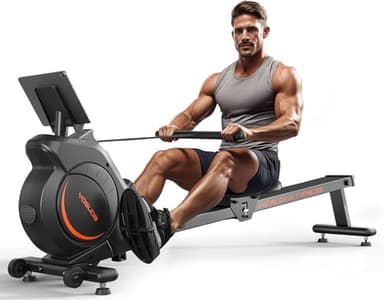
YOSUDA Magnetic Rower

YOSUDA Magnetic Rower

At 57.9 inches long and 43 lb it is the smallest full-stroke rower here — the one that fits a studio flat without a conversation about it.

Smallest footprint
2
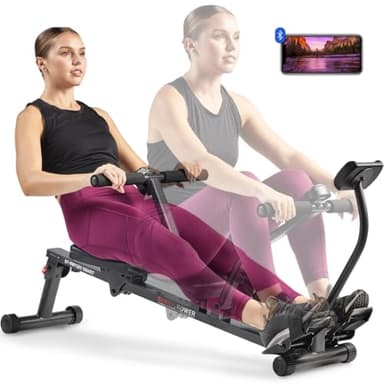
Sunny Health & Fitness Smart Compact Hydraulic Rower

Sunny Health & Fitness Smart Compact Hydraulic Rower

22.4 lb and 58 inches long — the cheapest and lightest way to start rowing, with all the compromises that implies.

Lightest
3
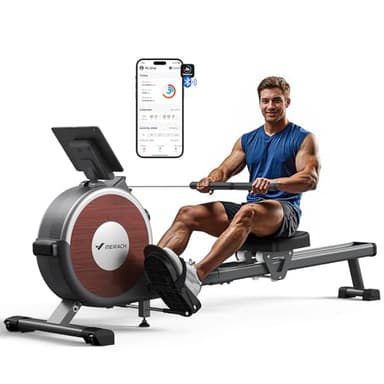
MERACH Q1S

MERACH Q1S

The budget rower that publishes the numbers the others hide: 350 lb capacity, users to 6 ft 7 in, 65 inches long, 58.9 lb — all stated on the listing.

Best compact with real specs
4
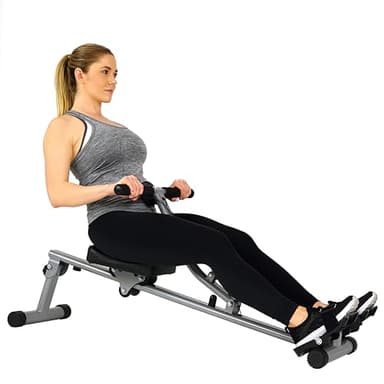
Sunny Health & Fitness SF-RW1205

Sunny Health & Fitness SF-RW1205

20.5 lb, twelve hydraulic levels, and the lowest price on this site — the machine you buy to find out whether you will actually row.

Cheapest compact

In detail

Every pick, and what is wrong with it

Each machine below gets the same four things: what it does well, what it does not, the five-year cost of owning it, and the case for buying something else instead.

YOSUDA Magnetic Rower rowing machine

1. Smallest footprint

YOSUDA Magnetic Rower

At 57.9 inches long and 43 lb it is the smallest full-stroke rower here — the one that fits a studio flat without a conversation about it.

Floor space: about 5.8 ft by 3.5 ft once you allow for handle travel and elbow room — roughly 20 sq ft.

What is good

  • 57.9 inches long is close to two feet shorter than a Concept2
  • 43 lb, so one person can stand it up and move it without planning
  • 16 magnetic levels, PU rollers, and a genuinely quiet action

What is not

  • YOSUDA does not publish a user weight limit for this model
  • A short machine means a short stroke — taller rowers will feel it
  • The app is a companion, not a class library

Skip this one if: Skip it if you are over about 6 feet — measure your own leg extension against 57.9 inches before you order.

Sunny Health & Fitness Smart Compact Hydraulic Rower rowing machine

2. Lightest

Sunny Health & Fitness Smart Compact Hydraulic Rower

22.4 lb and 58 inches long — the cheapest and lightest way to start rowing, with all the compromises that implies.

Floor space: about 5.8 ft by 3.7 ft once you allow for handle travel and elbow room — roughly 21 sq ft.

What is good

  • 22.4 lb. You can pick it up with one hand and put it behind a sofa
  • 12 hydraulic resistance levels and a device holder
  • Free SunnyFit app, no membership

What is not

  • Hydraulic cylinders heat up during longer sessions and the resistance drifts as they do
  • No published user weight limit
  • The stroke is nothing like a real rowing stroke; this is a cardio machine that resembles one

Skip this one if: Skip it if you want to learn to row properly — buy the cheapest magnetic machine instead, not this.

MERACH Q1S rowing machine

3. Best compact with real specs

MERACH Q1S

The budget rower that publishes the numbers the others hide: 350 lb capacity, users to 6 ft 7 in, 65 inches long, 58.9 lb — all stated on the listing.

Floor space: about 6.4 ft by 3.6 ft once you allow for handle travel and elbow room — roughly 23 sq ft.

What is good

  • 350 lb capacity and 6 ft 7 in maximum user height, both published — unusual candour at this price
  • Dual slide rail is more stable than the single rail most budget machines use
  • 16 magnetic levels and no subscription of any kind

What is not

  • 65 inches of rail is short if you are near the 6 ft 7 in ceiling — the limit and the comfortable limit are different numbers
  • Magnetic resistance does not build with stroke rate the way air does; hard efforts feel capped
  • 1-year manufacturer warranty

Skip this one if: Skip it if you plan to train intervals seriously — magnetic resistance at this price runs out of top end.

Sunny Health & Fitness SF-RW1205 rowing machine

4. Cheapest compact

Sunny Health & Fitness SF-RW1205

20.5 lb, twelve hydraulic levels, and the lowest price on this site — the machine you buy to find out whether you will actually row.

Floor space: about 5.5 ft by 3.7 ft once you allow for handle travel and elbow room — roughly 20 sq ft.

What is good

  • 20.5 lb, the lightest machine here by a clear margin
  • 12 resistance levels is generous for a hydraulic at this price
  • Leveling stabilizers, which cheap rowers usually omit

What is not

  • No published user weight limit
  • Hydraulic resistance drifts as the cylinders warm
  • There is no upgrade path — when you outgrow it you replace it entirely

Skip this one if: Skip it if you already know you will still be rowing in a year. Buy once at the next tier up instead.

How to choose

What actually decides this

In-use footprint, not folded size

Sort these machines by the floor they hold while you row and the order is clear. The Sunny SF-RW1205 is 54 by 20 inches. The YOSUDA magnetic is 57.9 by 17.7. The Sunny compact hydraulic is 58.1 by 20.1. The MERACH Q1S is 65 by 19.3. Every one of those is a number the machine keeps the entire time it is out, which is exactly what you want when the constraint is a small room rather than a cupboard.

Add the clearance every rower needs — roughly a foot of length for the handle at the catch and a couple of feet of width for your elbows at the finish — and the YOSUDA’s 57.9 inches becomes about 5.8 ft by 3.5 ft of working floor. The arithmetic behind that is here, applied the same way to every machine on the site.

The stroke-length trade you cannot avoid

A machine is short because its rail is short, and the rail is the part your seat slides along. At the catch your shins are near vertical and your seat is close to your heels; at the finish your legs are flat. The distance between those two is your inseam, and if the rail runs out first you stop the leg drive early and finish with your back instead.

This is why the smallest machine is not automatically the best one for you. The YOSUDA magnetic’s 57.9-inch frame is superb for a smaller rower and a small room, but a tall rower will feel the rail end before the stroke does. Measure your leg extension against the rail before buying anything this short. Compact is a fit decision, not just a floor-space one.

Why the two smallest here are hydraulic

The Sunny compact hydraulic and the SF-RW1205 are the shortest and lightest machines on this page — 22.4 lb and 20.5 lb respectively — and they are short for a structural reason. Hydraulic machines resist the handle with pistons rather than driving a seat along a long rail, so they simply do not need the length. That is what makes them tiny and cheap.

The catch is that hydraulic resistance drifts as the cylinders warm, and the stroke is a pull against a cylinder rather than a leg drive against a flywheel — so it does not row like a full rowing machine. At around $129 and $130 they are honest about what they are: the smallest, cheapest way to get a rowing-shaped cardio movement into a tight space. If you want a real rowing stroke in a compact frame, the magnetic machines are the ones to look at.

The compact machine that still fits a tall rower

The MERACH Q1S is the longest machine on this page at 65 inches, and it earns its place precisely because it publishes the numbers the others leave out: a 350 lb capacity, a stated fit up to 6 ft 7 in, a dual slide rail for stability, and 16 magnetic resistance levels. It is the compact machine that does not ask a taller or heavier rower to compromise, and it does it at around $190 with no subscription.

If you are near six feet or above and want something small, the Q1S is the pick. It is a few inches longer than the YOSUDA magnetic, and those few inches are the difference between a rail that fits your legs and one that does not.

Weight, and the machine you will actually move

A compact machine often lives somewhere and gets shifted for use — slid out from under a bed, moved from a wall. Weight decides whether that happens. The SF-RW1205 at 20.5 lb and the Sunny compact hydraulic at 22.4 lb are trivially light; the YOSUDA magnetic at 43 lb and the MERACH Q1S at 58.9 lb are more of a lift, though both are manageable and roll.

Pick the mechanism first — magnetic for a real stroke, hydraulic for the smallest and cheapest — then let weight and rail length settle the rest. If you also need it to fold away entirely, that is a different and complementary list.

Compact does not have to mean cheap

It is easy to assume a small machine is a throwaway machine, and at the very bottom of this list that is fair — the two hydraulics are inexpensive precisely because there is less machine there. But the MERACH Q1S shows that compact and well-specified are not opposites. On a 65-inch frame it still finds room for a dual slide rail, 16 magnetic levels, a published 350 lb capacity and a stated 6 ft 7 in fit, and it does it for around $190. Small is a constraint you can design well within, not an excuse for publishing nothing.

That is the useful filter for this page. Among machines of similar size, prefer the one that publishes real numbers — a rail length, a capacity, a resistance figure — over the one that offers only an overall length and a promise. A maker that states its specs on a small frame has thought about the compromise; a maker that hides them behind “space-saving design” is hoping you will not ask. The smallest machine that still tells you the truth about itself is almost always the better compact buy than a slightly smaller one that stays quiet.

The two hydraulic picks are the honest exception, and they earn their place by being upfront about the trade rather than dressing it up. At around $129 and $130 the Sunny compact hydraulic and SF-RW1205 are the smallest, lightest and cheapest way to get a rowing-shaped movement into a tight space, and neither pretends to be a full rowing machine. For a genuinely small room and a genuinely small budget, that honesty is worth more than a spec sheet that overreaches.

Straight answers

Questions people actually ask

What is the most compact rowing machine?

By in-use footprint among full-stroke machines, the YOSUDA magnetic rower at 57.9 by 17.7 inches and 43 lb is the smallest we cover. The Sunny hydraulic machines are shorter still - the SF-RW1205 is 54 by 20 inches - but they are hydraulic oar-style rowers rather than full-rail machines, which is why they can be that small. Compact is a fit decision as much as a size one, so check the rail length against your legs.

What is the difference between a compact and a foldable rowing machine?

A compact machine is small while you use it - its in-use footprint is the number that matters. A foldable machine is small when stored but returns to full length every time you row. If your constraint is clearing enough floor to row at all, compact is what you want; if you have the floor but nowhere to leave the machine, foldable solves that instead. The two goals sometimes overlap but they are not the same.

Are compact rowing machines good for tall people?

Only if the rail is long enough. A machine is compact because its rail is short, and a short rail runs out before a tall rower's legs reach full extension - which pushes the finish onto the lower back. The MERACH Q1S is the compact pick here that still fits taller rowers, publishing a 6 ft 7 in maximum user height on a 65-inch frame. Measure your leg extension against the rail before buying anything shorter.

Why are the smallest rowing machines hydraulic?

Because hydraulic machines resist the handle with pistons instead of driving a seat along a long rail, so they do not need the length a flywheel rower does. That is what makes the Sunny compact hydraulic and SF-RW1205 so short and light. The trade is that the resistance drifts as the cylinders warm and the stroke is a pull against a cylinder rather than a leg drive, so it does not row like a full machine.

How much floor space does a compact rowing machine need?

Add about a foot to the length and roughly two feet to the width for handle travel and elbow room. A 57.9-inch compact machine works out at about 5.8 ft by 3.5 ft of clear floor, against the nine feet an air rower wants. That gap is the whole reason to buy compact, and it is the same relationship Concept2 publishes between its 96-inch machine and its recommended 9 ft by 4 ft space.

Can a compact rowing machine give a real rowing workout?

A compact magnetic machine can - the YOSUDA magnetic and MERACH Q1S give a genuine leg-drive stroke in a small frame, limited mainly by rail length for taller rowers. The compact hydraulics are more of a rowing-shaped cardio movement than a true rowing stroke, because the piston resistance drifts and the motion is a pull rather than a drive. Match the machine to whether you want real rowing or just a small, cheap cardio option. If you want the smallest genuine leg-drive stroke, start with the YOSUDA magnetic and confirm the rail suits your legs; if a true stroke is not the priority and size is, the hydraulics win on footprint alone. Either way, measure your space and your inseam before you buy, because a compact machine that does not fit you is not a bargain.

The honest part

What we did not do

We have not rowed on these machines. We do not own them, there is no test lab here, and nobody writing this holds a coaching certification. Every ranking on this page is an argument from published specification and buyer fit, not from a stopwatch.

What we did do is read each manufacturer’s own published figures, record the ones they decline to publish, compute the floor space and the five-year cost, and date all of it. The full method is here so you can check our working or disagree with it.

Show your working

Sources

Keep going

Read next