Row & Recover

What the room below hears

Best Rowing Machines for an Upstairs Room

Rowing upstairs is three separate problems, and only one of them is noise. Five machines ranked on published weight, mechanism and whether one person can carry them up.

By Stephen V.An enthusiast who reads the manuals and does the math. Not a coach, not a lab.Last verified July 24, 2026.

We earn a commission if you buy through the links on this page, at no cost to you. It has no effect on what we recommend or the order we recommend it in — we say “skip this one” on machines that pay us the same as the ones we like. How we’re funded.

For a bedroom or spare room on a first floor, buy the MERACH Q1S: magnetic resistance, which is the quietest mechanism in this category; 58.9 lb, which one adult can get up a staircase; 65 inches long, which fits a room that is also used for something else; and a published 350 lb capacity, which is the only load figure any maker in this tier will give you. If nobody lives below you, skip to the Concept2 RowErg— it separates into two pieces for the stairs and it is a better machine in every respect except the one this page is about.

Rowing upstairs is three problems wearing one question, and conflating them is why people buy the wrong machine. The first is airborne noise, which is what a flatmate in the next room hears. The second is structure-borne noise — the low rumble of a seat carriage running on a rail, transmitted through the joists into the ceiling below, which is a completely different problem and the one that actually causes arguments. The third is simple logistics: a 100 lb machine in a flat-pack box, a turn in the staircase, and one person.

Here is the honest limit of what we can tell you. Not one manufacturer in this entire category publishes a decibel figure — not one, at any price — so anyone ranking rowing machines by measured noise is either testing them or making it up, and we are not testing them. What makers do publish is the resistance mechanism, the machine weight and the dimensions, and those three are enough to rank honestly, because the mechanism decides the kind of noise and the weight decides both the floor load and the stairs.

On the floor itself: a domestic timber floor built to code carries far more than a rower plus a rower. The figure worth doing is the sum, not the machine — a 68 lb machine and a 200 lb user is 268 lb spread over a footprint a couple of feet wide, which is less concentrated than a loaded bookcase and far less than a bathtub. If your floor already bounces when you walk across it, that is a question for a builder rather than for a spec sheet, and no rowing machine page should pretend otherwise.

The short answer

Quick picks

Ranked on published specification, buyer fit and what each machine costs to keep over five years. Select a row to jump to the full write-up. We have not rowed on these machines — here is exactly what we do instead.

#MachineBest forPrice
1
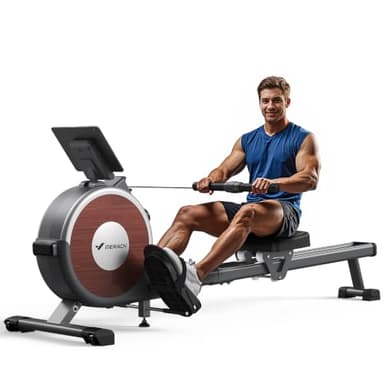
MERACH Q1S

MERACH Q1S

The budget rower that publishes the numbers the others hide: 350 lb capacity, users to 6 ft 7 in, 65 inches long, 58.9 lb — all stated on the listing.

Best all-round upstairs pick
$189.99 · Check price on Amazon

Price as of October 21, 2026. #ad How we’re funded

2
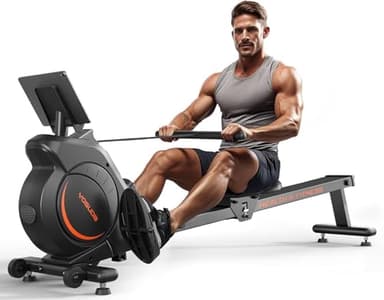
YOSUDA Magnetic Rower

YOSUDA Magnetic Rower

At 57.9 inches long and 43 lb it is the smallest full-stroke rower here — the one that fits a studio flat without a conversation about it.

Smallest magnetic footprint
$189.99 · Check price on Amazon

$269.9930% off

Price as of October 21, 2026. #ad How we’re funded

3
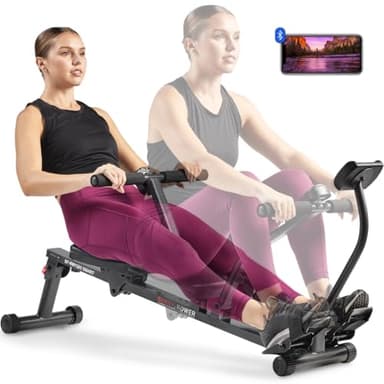
Sunny Health & Fitness Smart Compact Hydraulic Rower

Sunny Health & Fitness Smart Compact Hydraulic Rower

22.4 lb and 58 inches long — the cheapest and lightest way to start rowing, with all the compromises that implies.

Lightest to carry upstairs
$129.99 · Check price on Amazon

Price as of October 21, 2026. #ad How we’re funded

4
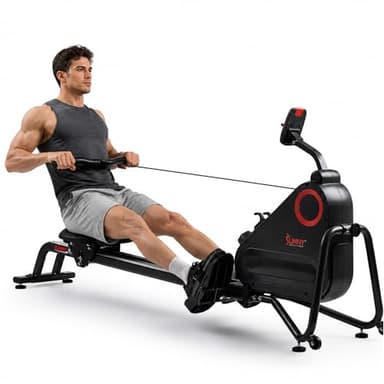
Sunny Health & Fitness Smart Dual-Rail Rower

Sunny Health & Fitness Smart Dual-Rail Rower

A 50-inch rail, 16 magnetic levels and a published 300 lb capacity, with covered dual rails that keep the running noise down.

Best full-length magnetic
$399.99 · Check price on Amazon

$479.9917% off

Price as of October 21, 2026. #ad How we’re funded

5
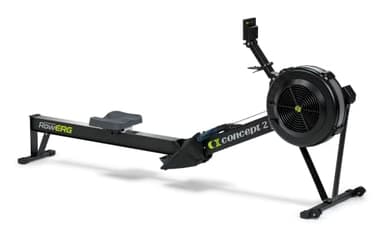
Concept2 RowErg

Concept2 RowErg

The machine every other rowing machine is measured against, and the only one here with no subscription, a 500 lb user limit and a five-year frame warranty at under a thousand dollars.

Best if nobody is below you
$990.00 · Check price on Amazon

Price as of October 21, 2026. #ad How we’re funded

In detail

Every pick, and what is wrong with it

Each machine below gets the same four things: what it does well, what it does not, the five-year cost of owning it, and the case for buying something else instead.

MERACH Q1S rowing machine

1. Best all-round upstairs pick

MERACH Q1S

The budget rower that publishes the numbers the others hide: 350 lb capacity, users to 6 ft 7 in, 65 inches long, 58.9 lb — all stated on the listing.

Five years of ownership: $190 — all of it the machine, none of it a subscription. See the full table

Floor space: about 6.4 ft by 3.6 ft once you allow for handle travel and elbow room — roughly 23 sq ft.

What is good

  • 350 lb capacity and 6 ft 7 in maximum user height, both published — unusual candour at this price
  • Dual slide rail is more stable than the single rail most budget machines use
  • 16 magnetic levels and no subscription of any kind

What is not

  • 65 inches of rail is short if you are near the 6 ft 7 in ceiling — the limit and the comfortable limit are different numbers
  • Magnetic resistance does not build with stroke rate the way air does; hard efforts feel capped
  • 1-year manufacturer warranty

Skip this one if: Skip it if you plan to train intervals seriously — magnetic resistance at this price runs out of top end.

$189.99 · Check price on Amazon

Price as of October 21, 2026. #ad How we’re funded

YOSUDA Magnetic Rower rowing machine

2. Smallest magnetic footprint

YOSUDA Magnetic Rower

At 57.9 inches long and 43 lb it is the smallest full-stroke rower here — the one that fits a studio flat without a conversation about it.

Five years of ownership: $190 — all of it the machine, none of it a subscription. See the full table

Floor space: about 5.8 ft by 3.5 ft once you allow for handle travel and elbow room — roughly 20 sq ft.

What is good

  • 57.9 inches long is close to two feet shorter than a Concept2
  • 43 lb, so one person can stand it up and move it without planning
  • 16 magnetic levels, PU rollers, and a genuinely quiet action

What is not

  • YOSUDA does not publish a user weight limit for this model
  • A short machine means a short stroke — taller rowers will feel it
  • The app is a companion, not a class library

Skip this one if: Skip it if you are over about 6 feet — measure your own leg extension against 57.9 inches before you order.

$189.99 · Check price on Amazon

$269.9930% off

Price as of October 21, 2026. #ad How we’re funded

Sunny Health & Fitness Smart Compact Hydraulic Rower rowing machine

3. Lightest to carry upstairs

Sunny Health & Fitness Smart Compact Hydraulic Rower

22.4 lb and 58 inches long — the cheapest and lightest way to start rowing, with all the compromises that implies.

Five years of ownership: $130 — all of it the machine, none of it a subscription. See the full table

Floor space: about 5.8 ft by 3.7 ft once you allow for handle travel and elbow room — roughly 21 sq ft.

What is good

  • 22.4 lb. You can pick it up with one hand and put it behind a sofa
  • 12 hydraulic resistance levels and a device holder
  • Free SunnyFit app, no membership

What is not

  • Hydraulic cylinders heat up during longer sessions and the resistance drifts as they do
  • No published user weight limit
  • The stroke is nothing like a real rowing stroke; this is a cardio machine that resembles one

Skip this one if: Skip it if you want to learn to row properly — buy the cheapest magnetic machine instead, not this.

$129.99 · Check price on Amazon

Price as of October 21, 2026. #ad How we’re funded

Sunny Health & Fitness Smart Dual-Rail Rower rowing machine

4. Best full-length magnetic

Sunny Health & Fitness Smart Dual-Rail Rower

A 50-inch rail, 16 magnetic levels and a published 300 lb capacity, with covered dual rails that keep the running noise down.

Five years of ownership: $400 — all of it the machine, none of it a subscription. See the full table

Floor space: about 7.6 ft by 3.6 ft once you allow for handle travel and elbow room — roughly 28 sq ft.

What is good

  • 50-inch rail — long enough for a full leg drive on most adults
  • Dual rails with protective coverings; the covers are doing acoustic work, not just cosmetic
  • 300 lb capacity published, and the SunnyFit app is free

What is not

  • 36.4 inches tall in use
  • 68 lb
  • 300 lb ceiling is lower than the MERACH Q1S at a higher price

Skip this one if: Skip it if you need more than 300 lb of capacity — the rail is excellent but the frame rating is the binding constraint.

$399.99 · Check price on Amazon

$479.9917% off

Price as of October 21, 2026. #ad How we’re funded

Concept2 RowErg rowing machine

5. Best if nobody is below you

Concept2 RowErg

The machine every other rowing machine is measured against, and the only one here with no subscription, a 500 lb user limit and a five-year frame warranty at under a thousand dollars.

Five years of ownership: $990 — all of it the machine, none of it a subscription. See the full table

Floor space: about 9.0 ft by 4.0 ft once you allow for handle travel and elbow room — roughly 36 sq ft.

What is good

  • 500 lb published user capacity — the highest figure any manufacturer on this page prints
  • No subscription, ever. The PM5 records everything on its own and ErgData is free
  • Separates into two pieces in seconds for storage; front and rear sections stand upright
  • Five-year frame warranty, and a parts supply chain that still serves machines from the 1990s

What is not

  • 96 inches long in use, and Concept2 recommends a 9 ft x 4 ft footprint — it is not an apartment-corner machine
  • Air resistance is the loudest kind. Concept2 publishes no decibel figure and neither do we
  • The 14-inch seat is low; getting up off it is a real consideration if your knees are the reason you are rowing

Skip this one if: Skip it if your floor space is under 9 feet in one direction, or if you share a wall with someone who sleeps early — this is the loud one.

$990.00 · Check price on Amazon

Price as of October 21, 2026. #ad How we’re funded

How to choose

What actually decides this

Three published figures and one judgement decide this. Here is what the makers print about the five picks.

Published resistance type, machine weight, length, storage method and user weight capacity for the five picks on this page
MachineResistanceMachine weightLengthStorage as publishedCapacity as published
MERACH Q1Smagnetic58.9 lb65 inUprightable, built-in base wheel350 lb
YOSUDA Magnetic Rowermagnetic43 lb57.9 inUprightableNot published
Sunny Health & Fitness Smart Compact Hydraulic Rowerhydraulic22.4 lb58.1 inCompact, no assembly storage modeNot published
Sunny Health & Fitness Smart Dual-Rail Rowermagnetic68 lb79.3 inUprightable300 lb
Concept2 RowErgair57 lb96 inSeparates into two pieces; 25 x 33 x 54 in stored500 lb

1. The mechanism, because it decides what kind of noise you make. Magnetic resistance is a brake acting on a flywheel with nothing moving air, which is why three of the five picks here are magnetic. Air resistance is a fan: it is the loudest mechanism in the category by a wide margin and the noise rises with your effort, which is exactly backwards for a shared house. Hydraulic is quiet because there is barely anything to make noise. Water sits in the middle and is the pleasantest sound of the four, but it is still a sound, and it is a sound at nine o’clock at night. The full comparison is on best quiet rowing machines and the mechanism in air vs magnetic.

2. The rail, because that is the sound that travels downward. The thing the room below hears is not the flywheel. It is the seat carriage running the length of the rail twenty times a minute, arriving through the floor rather than through the air, and no change of mechanism fixes it. Two things reduce it: a dense mat under the whole footprint, which is the single highest-return thing you can buy for an upstairs rower, and a slower, smoother stroke. Our own routine for the rail and rollers is in rowing machine seat rollers, the mat question is settled in do you need a mat under a rowing machine, and the rest of the quieting is in how to make a rowing machine quieter.

3. Machine weight, which is both the floor and the staircase. Sunny’s compact hydraulic rower is 22.4 lb, which is a one-handed carry. The YOSUDA magnetic is 43 lb and the MERACH Q1S 58.9 lb, both of which one adult can manage with a rest halfway. The Concept2 is 57 lb but separates into two pieces, which is a different and easier proposition on a turning staircase than a single 57 lb object. Above about 70 lb, assume two people — and note that the boxed weight is higher than the machine weight, so the box comes upstairs before it is a machine. Our assembly notes are in how to assemble a rowing machine.

4. Whether it stands up when you are done. An upstairs room is almost always a room with another job, so stored footprint matters more than footprint in use. Every pick here publishes an upright or compact storage method: the Q1S has a base wheel, the YOSUDA uprights, the Sunny hydraulic needs no assembly step to put away, and the Concept2 separates into a 25 by 33 by 54 inch stack. What none of them publishes is the ceiling height needed to upright it, so measure that yourself before you commit — the arithmetic is in space requirements.

The case against the obvious pick

The Concept2 RowErg is the better machine and it is last on this list, which deserves an explanation rather than a footnote. It is 96 inches long, which is eight feet of floor in a room that probably has a bed in it. It is an air rower, so it is the loudest option here and gets louder as you work harder. And Concept2 itself publishes a recommended 9 ft by 4 ft space, which is a great deal of a spare bedroom. All of that is survivable if the room below is a kitchen, a garage or nobody. If it is somebody’s bedroom, buy a magnetic machine and accept the smaller flywheel — the full version of that trade is on best rowing machines for apartments.

One thing we will not do is tell you a specific machine is safe on your specific floor. Floors differ, joist spans differ, and a hundred-year-old conversion is not a new build. What we can tell you is the published weight of each machine, which is the number a builder would ask you for first.

How to choose in one paragraph

Buy the MERACH Q1S for a first-floor room with someone underneath: magnetic, 58.9 lb, 65 inches, published 350 lb capacity. Buy the YOSUDA magnetic if the room is genuinely small — 57.9 inches and 43 lb. Buy Sunny’s compact hydraulic rower if the machine has to go up and down the stairs regularly, because 22.4 lb is the only weight on this page you will not resent. Buy the Sunny dual-rail machine if you are tall enough to need its published 50-inch rail and can take 68 lb up there once. And buy the Concept2 RowErg if nothing lives below you, because then none of this page applies and you should just buy the best machine. Whichever you choose, buy the mat at the same time.

Straight answers

Questions people actually ask

Can you put a rowing machine upstairs?

Yes, and the floor is rarely the problem. A domestic floor built to code carries a 68 lb machine plus a 200 lb user comfortably - that is less concentrated than a loaded bookcase. The real constraints are the low rumble the room below hears through the joists, and getting the machine up the staircase in the first place. Pick a magnetic machine under about 60 lb and put a dense mat under it.

Will a rowing machine upstairs disturb the room below?

Some, and the cause is not the one people expect. The flywheel noise travels through the air; the seat carriage running the rail travels through the floor, and that structure-borne rumble is what people in the room below actually complain about. A dense mat under the whole footprint is the single most effective fix, and no change of resistance mechanism removes it.

Which rowing machine is quietest for an upstairs room?

Magnetic resistance is the quietest mechanism in this category because nothing is moving air, and hydraulic is close behind because there is barely anything to make noise. Air is the loudest by a wide margin and gets louder the harder you work. Be aware that not one manufacturer in this category publishes a decibel figure, so anyone ranking machines by measured noise is testing them or inventing it.

How much weight can an upstairs floor take for a rowing machine?

That is a question for a builder rather than a rowing machine site, because it depends on joist span, age and construction. What we can give you is the figure they will ask for: the published machine weight, which runs from 22.4 lb for a compact hydraulic rower to 145 lb for the heaviest connected machines we track. Add your own weight to it and that is the load.

Can one person carry a rowing machine upstairs?

Under about 60 lb, usually yes, with a rest halfway. The Concept2 RowErg is 57 lb but separates into two pieces, which is easier on a turning staircase than one 57 lb object. Above roughly 70 lb, plan for two people - and remember the boxed weight is higher than the machine weight, so the box goes up before it is a machine.

Do I need a mat for a rowing machine on an upstairs floor?

It is the highest-return thing you can buy for an upstairs rower. A dense mat under the whole footprint cuts the rumble that reaches the ceiling below, stops the feet creeping on a hard floor and protects the floor itself. Size it a little longer and wider than the machine.

The honest part

What we did not do

We have not rowed on these machines. We do not own them, there is no test lab here, and nobody writing this holds a coaching certification. Every ranking on this page is an argument from published specification and buyer fit, not from a stopwatch.

What we did do is read each manufacturer’s own published figures, record the ones they decline to publish, compute the floor space and the five-year cost, and date all of it. The full method is here so you can check our working or disagree with it.

Show your working

Sources

Keep going

Read next