Review
WaterRower Natural Review
Hand-built ash, stores on end in about two square feet, no subscription — and one important number WaterRower declines to publish.
We earn a commission if you buy through the links on this page, at no cost to you. It has no effect on what we recommend or the order we recommend it in — we say “skip this one” on machines that pay us the same as the ones we like. How we’re funded.
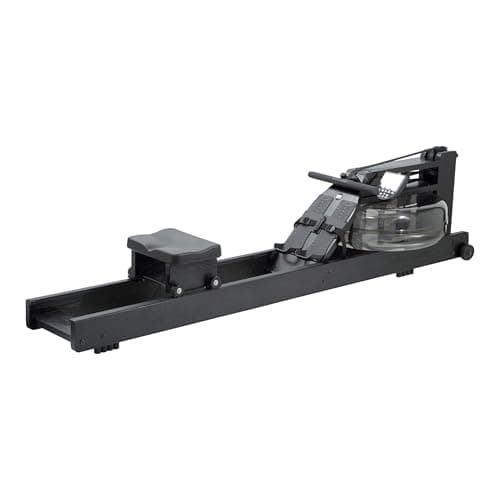
WaterRower Natural (Ash)
Hand-built in Rhode Island from sustainably sourced ash, stores on end in about two square feet, and has no subscription attached to it at all.
Skip this one if: Skip it if you want split times and watts to compare against other rowers — the S4 is a fine monitor but the Concept2 PM5 is the sport's common language.
Price as of October 23, 2026. #ad How we’re funded
The WaterRower was designed in the mid-1980s by John Duke, a Yale and US National Team rower, and it has been hand-built in Rhode Island ever since from sustainably sourced timber. That is not marketing copy we are repeating uncritically — it is on WaterRower’s own listing and it is the reason the machine costs what it does.
What you are buying is a rowing machine that behaves like furniture. It is 82 inches long and 22 inches wide in use, and it stands on its front end when you are done, occupying roughly two square feet. That is the footprint of a floor lamp, and for a machine that has to live in a room you also live in, it is the most compelling practical argument in the category.
The published numbers
Specifications, and the gaps
Every row below is either a figure the manufacturer publishes or the words “Not published”. We do not estimate, and we do not fill a gap with a number from a review site.
| Specification | WaterRower Natural (Ash) |
|---|---|
| Resistance | water |
| Length | 82 in |
| Width | 22 in |
| Height | 20 in |
| Floor space you actually need | 7.8 ft x 3.8 ft (about 30 sq ft)Our arithmetic, not a manufacturer figure: published length + 12 in for handle travel at the catch, published width + 24 in for elbow room. |
| Machine weight | 103.5 lb |
| Maximum user weight | Not published |
| Maximum user height | Not published |
| Seat height | Not published |
| Rail length | Not published |
| Monitor | S4 |
| Storage | Stands upright on end |
| Mains power required | No |
| Warranty | Not published |
| Noise (decibels) | Not publishedNo manufacturer on this site publishes a decibel figure for any machine. We will not estimate one. |
| Subscription | NoneNo subscription. The monitor works standalone out of the box. |
Specifications read from WaterRower’s published listing, accessed 2026-07-24. Last verified July 24, 2026.
| Specification | WaterRower Club |
|---|---|
| Resistance | water |
| Length | 83 in |
| Width | 24 in |
| Height | 21 in |
| Floor space you actually need | 7.9 ft x 4.0 ft (about 32 sq ft)Our arithmetic, not a manufacturer figure: published length + 12 in for handle travel at the catch, published width + 24 in for elbow room. |
| Machine weight | 117 lb |
| Maximum user weight | Not published |
| Maximum user height | Not published |
| Seat height | Not published |
| Rail length | Not published |
| Monitor | S4 BLE |
| Storage | Stands upright on end |
| Mains power required | No |
| Warranty | Not published |
| Noise (decibels) | Not publishedNo manufacturer on this site publishes a decibel figure for any machine. We will not estimate one. |
| Subscription | NoneNo subscription. The monitor works standalone out of the box. |
Specifications read from WaterRower’s published listing, accessed 2026-07-24. Last verified July 24, 2026.
The published specifications
- 82 in long, 22 in wide, 20 in highin use, per WaterRower’s own listing text.
- 103.5 lb filled with water. That is what you are lifting when you stand it up, and it is worth registering before you order.
- S4 monitor on the Natural; S4 BLE on the Club and Oak, which pairs with phone apps out of the box.
- Stores on end in roughly 22 x 20 in.
- No subscription, ever. The S4 is self-contained.
The number that is missing
WaterRower does not publish a maximum user weight on its Amazon listings for either the Natural or the Club.
We are not going to fill that gap with a guess. What we can do is put it in context: YOSUDA publishes 400 lb for its wooden water rower and a 6 ft 6 in maximum user height; MERACH publishes 400 lb; Sunny publishes 300 lb for the Phantom Hydro; Fitness Reality publishes 300 lb; Concept2 publishes 500 lb.
Every one of those is a cheaper machine than the WaterRower Natural, and every one of them tells you the number. If you are near any reasonable ceiling, that omission is worth an email to WaterRower before you spend $1,700. This is exactly the sort of gap this site exists to point at rather than paper over.
How the water actually feels
The resistance comes from paddle-like blades turning in a tank of water, and it rises with paddle speed. Pull harder and the water resists harder — there is no dial and no ceiling. That is the same self-regulating property that makes air rowers good, arrived at differently.
What is different is the sound and the damping. Wood absorbs vibration in a way welded steel does not, and the noise is a low-frequency whoosh rather than a fan. Low frequencies carry through walls less readily than broadband noise, which makes this a more workable apartment machine than an air rower despite not being silent.
As always: WaterRower publishes no decibel figure and neither do we. Here is why nobody does.
The storage argument, in detail
Standing on end is the WaterRower’s real feature and it deserves more than a bullet point.
Most “storable” rowing machines fold, which converts length into height and leaves you with a tall object to house. Concept2 separates into two pieces, which is fast but leaves you with two objects. The WaterRower goes vertical as one piece and leans against a wall taking up about two square feet.
Two caveats. It is 103.5 lb filled, so this is a deliberate two-handed act. And it wants a wall — a seven-foot wooden object standing free in a room with children or pets around is a hazard, not a storage solution.
Natural or Club?
The Club is the commercial-specification version: 83 in by 24 in, 117 lb dry, a higher seat and the S4 BLE monitor as standard.
The higher seat is the reason to consider it. If you found a WaterRower Natural awkward to get off — and at 20 inches high in use the seat itself sits low — the Club addresses that directly. Otherwise you are paying for durability specified for a gym’s usage rather than a spare bedroom’s.
Running costs
Small but real. The tank is treated with purification tablets a few times a year to prevent algae, and the level needs occasional topping up. Nothing else. There is no subscription, no consumable belt, no service interval.
Over five years that is a handful of tablets against $3,000 for a Hydrow membership. The table is worth looking at.
The case against
The monitor. The S4 is a perfectly good monitor and it is not the PM5. If you want split times that mean something to other rowers, or you intend to do erg tests, Concept2 owns that territory and it is not close.
The price. The Natural costs roughly $1,700 against a $990 Concept2, both with no subscription. You are paying for hand-built ash, the vertical storage and the sound. Those are real things, and they are aesthetic and practical rather than performance-related.
The unpublished capacity. Covered above, and genuinely disqualifying if you are near a ceiling.
What we did not do
We have not rowed a WaterRower. Everything here comes from WaterRower’s published listing text and specifications, read on 24 July 2026.
One footnote on paperwork, since WaterRower publishes none of it here: the newer XTERRA ERG750Wstates a five-year frame warranty on its own listing, which is the only multi-year frame figure published by any water rower we cover. It is a cheaper, heavier machine with no published weight capacity, so it is not a like-for-like substitute — but if a written frame term is part of what you are buying, it is the water rower that gives you one.
The number that decides it
What five years actually costs
Live machine price plus sixty months of whatever subscription the manufacturer requires. Prices update daily and expire on their own after 48 hours.
| Machine | Machine price | Subscription | Year 1 | Year 3 | Year 5 |
|---|---|---|---|---|---|
| WaterRower Club | $1,424 | None | $1,424 | $1,424 | $1,424 |
| WaterRower Natural (Ash) | $1,730 | None | $1,730 | $1,730 | $1,730 |
Machine prices are live from Amazon as of October 23, 2026 and change without notice. Subscription figures are the published month-to-month rates, each cited on the subscriptions page. Totals are machine price plus the monthly rate multiplied by 12, 36 and 60. We do not model electricity, shipping, floor mats or resale value — each would need an assumption we cannot source, and adding them would make the number look more precise while making it less true.
Where to buy
If this is the one
WaterRower Natural (Ash)
Price as of October 23, 2026. #ad How we’re funded
WaterRower Club
Price as of October 23, 2026. #ad How we’re funded
Straight answers
Questions people actually ask
What is the WaterRower Natural weight limit?
WaterRower does not publish a maximum user weight on its Amazon listings for the Natural or the Club, and we will not estimate one. For context, YOSUDA publishes 400 lb for its wooden water rower, MERACH publishes 400 lb, Sunny publishes 300 lb and Concept2 publishes 500 lb - all cheaper machines that state the number. If you are near a ceiling, contact WaterRower before buying.
How much space does a WaterRower need when stored?
About two square feet - roughly 22 by 20 inches - because it stands upright on its front end as a single piece. That is the most compact stored footprint of any machine we cover. It weighs 103.5 lb filled, so standing it up is a deliberate two-handed act, and it needs a wall to lean against.
Does a WaterRower need a subscription?
No. The S4 monitor is self-contained and WaterRower has never charged a membership fee. The only ongoing cost is water purification tablets a few times a year to prevent algae in the tank, plus occasional topping up of the water level.
Is the WaterRower quiet?
It produces a low-frequency whoosh from the paddles moving through water, roughly comparable to a shower running. Most people find it pleasant, and low frequencies carry through walls less readily than the broadband noise an air rower makes. WaterRower publishes no decibel figure, and no manufacturer on this site does, so treat specific numbers elsewhere with suspicion.
WaterRower Natural or Club - which should I buy?
The Club if you want the higher seat, which makes getting on and off noticeably easier. Otherwise the Natural. The Club is the commercial-specification version at 117 lb dry with the S4 BLE monitor as standard, built for a gym's hours rather than a home's - durability most home rowers will never exhaust.
WaterRower or Concept2?
Concept2 for performance and comparable numbers; WaterRower for living with. The Concept2 costs less, has a published 500 lb capacity, a five-year frame warranty and the PM5 monitor whose split times other rowers recognize. The WaterRower stores upright in two square feet, is far quieter, and looks like furniture. Neither has a subscription.
Show your working
Sources
- WaterRower Natural (Ash) — published specificationsAccessed 2026-07-24. https://www.amazon.com/dp/B0053BMWWU?tag=t5fitness-20
- WaterRower Club — published specificationsAccessed 2026-07-24. https://www.amazon.com/dp/B0053BMXEW?tag=t5fitness-20
- WaterRower Oak with S4 BLE — published specificationsAccessed 2026-07-24. https://www.amazon.com/dp/B00KXD5HPC?tag=t5fitness-20
- Concept2 — Compare indoor rowers (official specifications)Accessed 2026-07-24. https://www.concept2.com/indoor-rowers/compare
Keep going
Read next
- Best water rowing machinesSeven water rowers from $250 to $1,700.
- Concept2 vs WaterRowerThe storage difference that usually decides it.
- Rowing machines with no subscriptionBoth machines on this page qualify.
- Best rowing machines for apartmentsWhere two square feet of stored footprint counts.
- WaterRower vs Sunny Obsidian SurgeHand-built ash against a steel water rower at a quarter of the price.
- Best wooden rowing machinesThe material-first roundup, from ash to folding beech.
- WaterRower Natural vs ClubAsh against a steel rail with a higher seat.
- What is a water rower?How the tank and paddles actually work.
- Ergatta rower reviewThe WaterRower with a racing-game screen on top.