Magnetic, hydraulic or water at this price?
At the budget end you are really choosing between three mechanisms, and they are not equally good.
Magnetic is the default and the right default. A magnet moves closer to or further from a metal flywheel; resistance is set by a dial and stays where you put it. It is near-silent, it needs no maintenance, and the resistance is consistent from the first minute to the fortieth. Every magnetic machine here is a reasonable purchase.
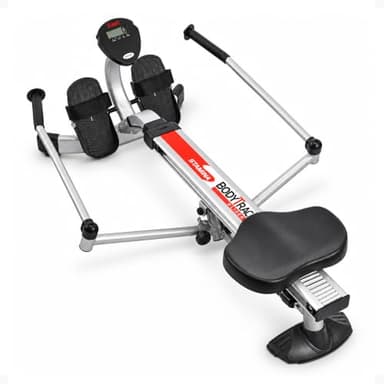
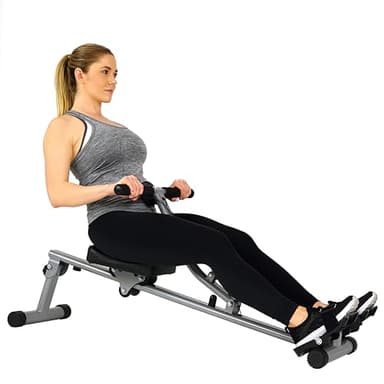
Hydraulic is what you get at the very bottom. Two pistons resist the handle, and they get warm as you use them. Warm hydraulic fluid is thinner fluid, so the resistance you set at the start is not the resistance you have at minute twenty. It also does not row like a rowing machine — the stroke is a pull against a cylinder, not a drive against a flywheel. The Sunny SF-RW1205 and the Stamina Body Trac are both good examples of the type, and both are here because at their prices they are honest about what they are.
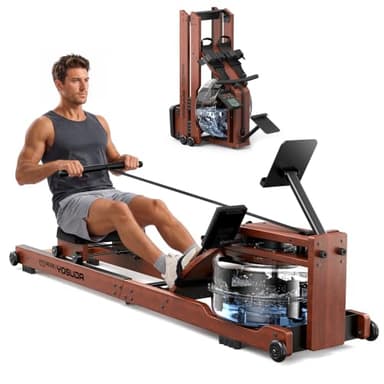
Water at this price is a genuine surprise. The YOSUDA folding beech machine gives you a 22-liter tank, a 400 lb published capacity, a stated fit up to 6 ft 6 in, and a 180-degree fold — for a fraction of what a WaterRower costs. It is not the same machine, and the frame tells you so, but the water sound and the progressive resistance are real.
The floor-space trap
A budget listing will tell you the machine is 65 inches long and leave you to conclude that 65 inches of floor is enough. It is not. At the catch your hands travel forward past the flywheel, and at the finish you need room behind the seat. Concept2 is the only manufacturer that publishes both figures — a 96-inch machine with a recommended 9 ft by 4 ft space — and the gap between those two numbers is a foot of length and two feet of width.
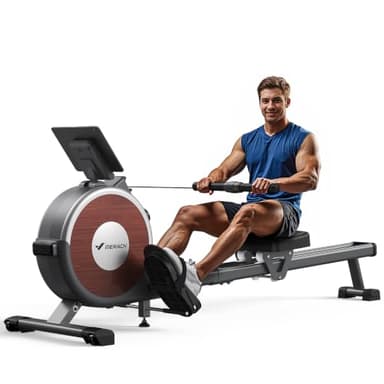
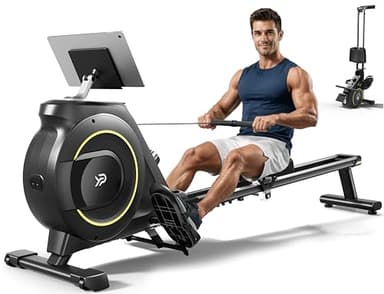
We apply that same published relationship to every machine on this site and label it as our arithmetic rather than a manufacturer figure. On the MERACH Q1S it turns 65 inches into about 6.4 ft by 3.6 ft. On the YOSUDA magnetic it turns 57.9 inches into about 5.8 ft by 3.5 ft. The full calculation is here.
What you are giving up
Three things, and it is worth being clear about all of them.
Top-end resistance. Magnetic resistance is fixed by the dial. On an air rower, pulling harder makes the fan spin faster, which makes the air resist more — the machine matches whatever you give it. On a magnetic machine there is a ceiling, and a fit rower will find it. If you intend to train intervals seriously, that ceiling is the reason to spend more.
Comparable numbers.Concept2’s PM5 monitor is the sport’s common currency; a 2,000m time on one means something everywhere. Budget monitors report distance and calories using their own arithmetic, and those numbers do not transfer.
Parts in year six. Concept2 still supplies parts for machines built in the 1990s. Most brands here offer a one-year warranty and no parts catalog at all. If something breaks in year three you are usually buying another machine.
None of that makes a budget rower a bad purchase. It makes it a different purchase, and the honest question is whether you will still be rowing in eighteen months. The five-year cost table is a useful way to think about it: a $190 machine you replace twice costs more than a $990 machine you keep.