Do the measurement before you read the reviews
Take a tape measure to the space you actually intend to use. Not the room — the space. Then check three things:
- Length, plus a foot. A 65-inch machine wants about 6.4 ft of clear floor. A 96-inch machine wants 9 ft. That is usually the binding constraint.
- Width, plus two feet. Your elbows go out at the finish. A 19-inch machine wants roughly 3.6 ft of width to row in without clipping a wall or a table leg.
- Where it lives when you are not on it. This is the one people skip, and it is the reason machines end up on a marketplace listing after four months. A folding machine needs somewhere to fold to.
Stored footprint is the real spec
Three storage strategies exist and they are not equivalent.
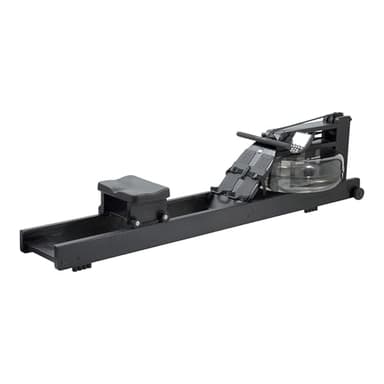
Standing on end is the best of them. The WaterRower Natural stands upright on its front end and occupies roughly 22 by 20 inches of floor — about two square feet. That is the same as a floor lamp. It is also 103.5 lb filled with water, so standing it up is a deliberate act rather than a casual one.
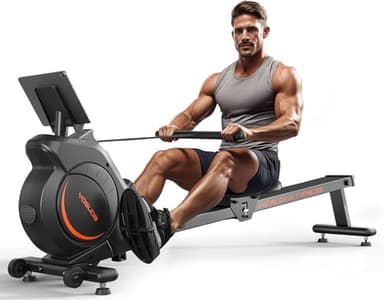
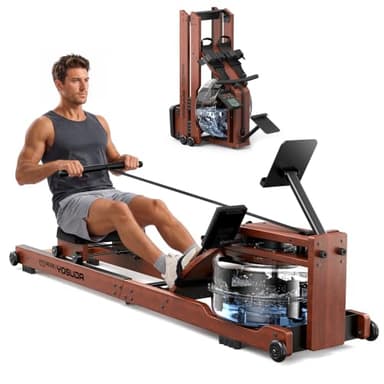
Folding trades length for height. The YOSUDA water rower folds 180 degrees and rolls; Circuit Fitness publishes both dimensions for its machine — 91 inches down to 49 inches, but 31.5 inches tall becomes 51 inches tall. You gain floor and lose a corner.
Separating into two pieces is what Concept2 does. It is fast and it works, but you now have two objects to put somewhere instead of one.
The noise problem, honestly
We checked every manufacturer represented on this site for a published decibel figure. We found none. Not Concept2, not Hydrow, not Sunny, not MERACH, not YOSUDA. Every noise number you have read in a rowing machine review was produced by somebody with a phone app in a room you know nothing about.
So decide on mechanism instead, which is knowable:
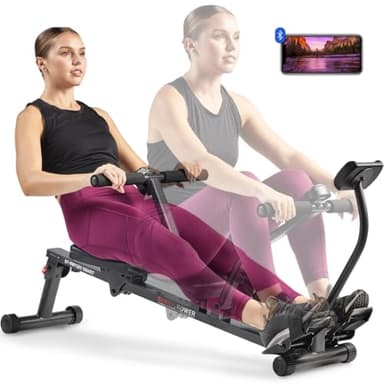
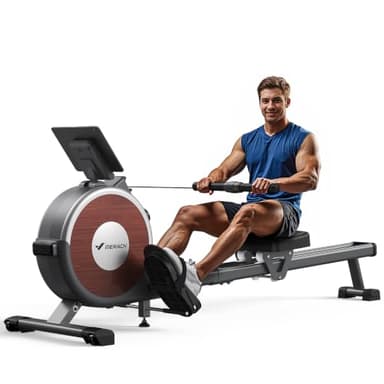
- Magneticis quietest. A magnet near a flywheel makes no sound at all; what you hear is the seat rolling and the belt. Covered rails, like the Sunny Dual-Rail’s, reduce even that.
- Water is a whoosh — genuinely pleasant, and low-frequency enough that it carries less through a wall than you would expect.
- Air is a fan. It is the loudest by a wide margin, and it is broadband noise that travels. In an apartment with shared walls this is the wrong choice, whatever else the machine does well.
And the noise nobody talks about: impact through the floor. The seat returning and the handle stopping both transmit downwards. A rubber mat under the machine does more for your relationship with the flat below you than any resistance type will. More on this here.
The connected-rower exception
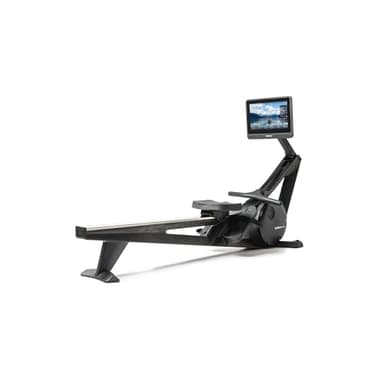
The Hydrow Wave is on this page for one reason: at 19 inches wide it is the narrowest serious connected rower made, it uses electromagnetic resistance so it is near-silent, and it folds upright.
The catch is the $50 a month, which over five years adds $3,000 — more than most machines on this site cost outright. That comparison is worth reading before you commit, because in a small space the honest alternative is a $190 magnetic rower and a tablet on a stand.
A first-floor room adds a problem this page does not solve: the rumble a seat carriage sends down through the joists into the ceiling below, which is a different thing from the noise that travels through the air and is not fixed by changing the resistance mechanism. That one, plus who carries the machine up the stairs, is on best rowing machines for an upstairs room.