Row & Recover

Two arms, not one handle

Best Full-Motion Rowing Machines

A full-motion rower swings two arms through an arc instead of pulling one handle straight back. Three machines here publish it, only one of them has a flywheel, and all of them are a foot wider than a normal rower.

By Stephen V.An enthusiast who reads the manuals and does the math. Not a coach, not a lab.Last verified July 24, 2026.

We earn a commission if you buy through the links on this page, at no cost to you. It has no effect on what we recommend or the order we recommend it in — we say “skip this one” on machines that pay us the same as the ones we like. How we’re funded.

The pick is the MERACH R26 Sculls. It is the only full-motion machine we track with magnetic resistance and a flywheel rather than hydraulic pistons, it publishes two independent handles travelling through a 120-degree arc, and it publishes a 76-inch maximum user height. It suits someone who wants the sculling motion without giving up a resistance level they can set and leave. The budget pick is the Stamina Body Trac Glider 1050 — the cheapest full-motion machine here, 38 lb, it folds, and Stamina has sold it largely unchanged for about two decades. Prices as of November 12, 2026, each stamped beside the machine it belongs to.

First, what the phrase means, because listings use it loosely. On a conventional indoor rower one handle on a strap or chain travels in a straight line toward you. On a full-motion machine two separate arms pivot outward and back through an arc, the way oars do in a boat. The two motions load the upper back differently: the arc asks more of the rear deltoid and the mid-trapezius and lets each arm work independently, which is why people with a shoulder that does not like a fixed bar often get on better with it.

Second, the honest cost of it. Only three machines on this site publish a full-motion stroke, and two of the three are hydraulic, which means no flywheel and resistance that drifts as the cylinder warms. All three are also around 30 inches wide rather than the 16 to 22 inches a normal rower occupies, because the arms need somewhere to go. If you want a machine that teaches you an erg stroke, this is the wrong category and best magnetic rowing machines is the right one.

The short answer

Quick picks

Ranked on published specification, buyer fit and what each machine costs to keep over five years. Select a row to jump to the full write-up. We have not rowed on these machines — here is exactly what we do instead.

#MachineBest forPrice
1
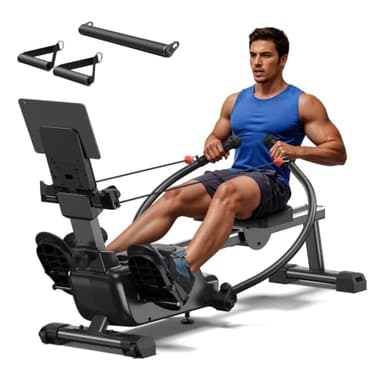
MERACH R26 Sculls

MERACH R26 Sculls

Two independent handles moving through a 120-degree arc — the closest a home machine gets to sculling, and a completely different upper-back stimulus.

Best overall, and the only magnetic one
$359.99 · Check price on Amazon

Price as of November 12, 2026. #ad How we’re funded

2
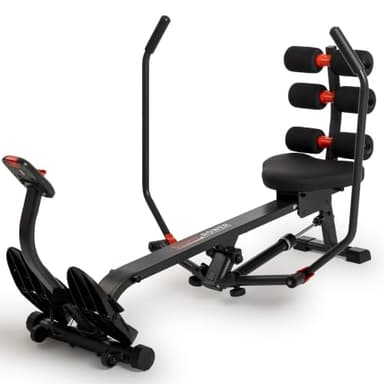
Sunny Health & Fitness SF-RW525023 2-in-1 Full Motion Rower with Core Trainer

Sunny Health & Fitness SF-RW525023 2-in-1 Full Motion Rower with Core Trainer

The only machine we have found whose maker publishes a built-in back pad: a cushioned back-assist seat on six foam rollers, plus a seat that locks at five points along the rail.

Best for seated and supported work
$269.99 · Check price on Amazon

$299.9910% off

Price as of November 12, 2026. #ad How we’re funded

3
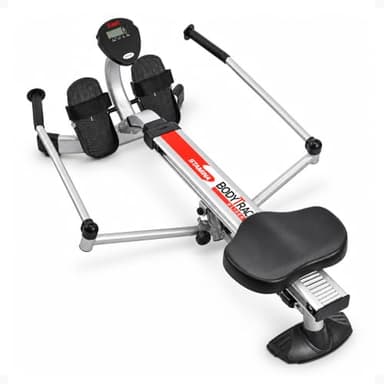
Stamina Body Trac Glider 1050

Stamina Body Trac Glider 1050

Full-motion rowing arms that swing outward like oars, 38 lb, 250 lb capacity — an honest budget machine that has been sold for two decades.

Budget pick: cheapest full-motion arms
$194.99 · Check price on Amazon

Price as of November 12, 2026. #ad How we’re funded

In detail

Every pick, and what is wrong with it

Each machine below gets the same four things: what it does well, what it does not, the five-year cost of owning it, and the case for buying something else instead.

MERACH R26 Sculls rowing machine

1. Best overall, and the only magnetic one

MERACH R26 Sculls

Two independent handles moving through a 120-degree arc — the closest a home machine gets to sculling, and a completely different upper-back stimulus.

Five years of ownership: $360 — all of it the machine, none of it a subscription. See the full table

Floor space: about 6.0 ft by 4.5 ft once you allow for handle travel and elbow room — roughly 27 sq ft.

What is good

  • Independent arms allow one-arm, alternating and synchronized strokes; a single-handle rower cannot do any of that
  • 80 lb of peak magnetic resistance across 16 levels
  • Fits users to 6 ft 4 in, published, with stated dimensions of 60.6 x 29.5 x 28.3 in

What is not

  • 29.5 inches wide, because the arms need somewhere to go
  • The stroke is not the one you will meet on a Concept2 in a gym, so times do not transfer
  • No published user weight limit

Skip this one if: Skip it if you are training for indoor rowing specifically — this is a different movement, not a cheaper version of the same one.

$359.99 · Check price on Amazon

Price as of November 12, 2026. #ad How we’re funded

Sunny Health & Fitness SF-RW525023 2-in-1 Full Motion Rower with Core Trainer rowing machine

2. Best for seated and supported work

Sunny Health & Fitness SF-RW525023 2-in-1 Full Motion Rower with Core Trainer

The only machine we have found whose maker publishes a built-in back pad: a cushioned back-assist seat on six foam rollers, plus a seat that locks at five points along the rail.

Five years of ownership: $270 — all of it the machine, none of it a subscription. See the full table

Floor space: about 5.7 ft by 4.5 ft once you allow for handle travel and elbow room — roughly 25 sq ft.

What is good

  • Sunny publishes a built-in Back-Assist Core Trainer - a cushioned seat plus six foam rollers that give the back something to rest against
  • The seat glides for normal rowing or locks at five positions on the rail, so the machine can be used seated-and-supported rather than sliding
  • 400 lb published capacity and a 3-year structural frame warranty, which is three times the term most budget rowers publish

What is not

  • The back pad is for the fixed-seat and core exercises, not for the rowing stroke - no maker, including Sunny, publishes a backrest you row against
  • Hydraulic resistance does not reward hard training: 12 cylinder levels, no flywheel, and the feel changes as the cylinder warms
  • 29.7 inches wide and 31.1 inches tall - a wider and taller footprint than any other budget rower we track, because the dual arms need the room

Skip this one if: Skip it if what you actually want is a long, smooth stroke on a flywheel - a full-motion hydraulic machine with a back pad is a different exercise, and the Concept2 is the better rowing machine.

$269.99 · Check price on Amazon

$299.9910% off

Price as of November 12, 2026. #ad How we’re funded

Stamina Body Trac Glider 1050 rowing machine

3. Budget pick: cheapest full-motion arms

Stamina Body Trac Glider 1050

Full-motion rowing arms that swing outward like oars, 38 lb, 250 lb capacity — an honest budget machine that has been sold for two decades.

Five years of ownership: $195 — all of it the machine, none of it a subscription. See the full table

What is good

  • The arms swing through an arc rather than pulling a single strap, which better resembles sculling
  • 38 lb and folds — genuinely storable in a cupboard
  • 250 lb published capacity, stated on the listing

What is not

  • 250 lb is the lowest capacity on this site
  • Hydraulic cylinders, with the same warm-up drift as any hydraulic machine
  • Stamina does not publish assembled dimensions in a usable form on this listing, so we do not print any

Skip this one if: Skip it if you are over about 200 lb — you will be close enough to the published ceiling to worry about it.

$194.99 · Check price on Amazon

Price as of November 12, 2026. #ad How we’re funded

How to choose

What actually decides this

Width is the spec that decides this, not length

Every buying guide in this category talks about length. For a full-motion machine the number that bites is width, because the arms sweep outward and you cannot put the machine in a corridor.

Published width, length, maximum user weight and maximum user height for the three full-motion machines we track
MachineWidth in useLength in useMax user weightMax user height
MERACH R26 Sculls29.5 in60.6 inNot published76 in
Sunny Health & Fitness SF-RW525023 2-in-1 Full Motion Rower with Core Trainer29.7 in56.2 in400 lbNot published
Stamina Body Trac Glider 1050Not publishedNot published250 lbNot published

Two of the three publish 29.5 and 29.7 inches of width. That is a foot wider than the YOSUDA magnetic rower and five inches wider than a Concept2, on machines that are 35 inches shorter. The trade is real and it favours a square room over a narrow one: a full-motion machine fits where a 96-inch erg cannot, provided you have width to give it. How much space a rowing machine needs has the clearance figures, and the arm sweep is the reason we tell people to measure both directions.

The Stamina publishes no assembled dimensions in a usable form, so the table says so rather than printing a guess. It does publish 38 lb and a 250 lb capacity — the lowest capacity figure on this entire site, and the reason we would not recommend it to anyone near 200 lb.

Why the MERACH is the one to buy

It is the only machine in the category with a flywheel. Hydraulic pistons are what make a full-motion frame cheap: they are small, they mount at the pivot, and they need no belt. They also heat up. Over a thirty-minute session the resistance you started with is not the resistance you finish with, which makes any kind of interval work guesswork. Hydraulic against magnetic resistance goes through the mechanism.

The MERACH publishes magnetic resistance with a performance monitor and Bluetooth, and it publishes the arc figure (120 degrees) and a 76-inch user ceiling, which no other machine in the category does. It is 85 per cent pre-assembled and uprightable. It is also the most expensive of the three by a clear margin, and we think that is the right place to spend here: a full-motion machine with drifting resistance is a novelty, and one with a flywheel is a training tool.

The Sunny is a different proposition entirely

The Sunny SF-RW525023 is the only machine on this site whose maker publishes a built-in back pad: a cushioned back-assist seat on six foam rollers, with a seat that either glides for normal rowing or locks at five positions along the rail. That second mode is what makes it unusual — it turns the machine into a fixed-seat upper-body station, so the arms do the work with the back supported.

Be clear about what that pad is and is not. It is for the fixed-seat and core exercises, not for the rowing stroke: no maker, Sunny included, publishes a backrest you row against, and best rowing machines with back support says exactly that at length. Sunny publishes 400 lb and a three-year structural frame warranty on this machine, which is three times the term most budget rowers print, and it is the pick if the reason you are looking at dual arms is that a long reach forward is the part that hurts.

Who should not buy one

  • Anyone training for a 2k. The arc is not an erg stroke. Nothing you learn on a full-motion machine transfers to a Concept2 test or to a boat, and rowing machine against seated row explains why the distinction matters.
  • Anyone over about 300 lb. One machine here publishes 400 lb. The other published figure is 250 lb, and the third machine publishes nothing — best rowing machines for heavy and tall rowers is the better list.
  • Anyone rowing in a narrow room. Thirty inches of width with arms moving through it is not negotiable.
  • Anyone who wants published resistance numbers. Hydraulic cylinder levels are not comparable between machines, and only the MERACH gives you something a second machine could be measured against.

If what you actually want is one frame that does two jobs rather than one stroke that works differently, best 2-in-1 rowing machines is the page next door — and the Sunny appears on both, because it is the only machine that genuinely belongs in both categories.

Straight answers

Questions people actually ask

What is a full-motion rowing machine?

One where two separate arms pivot outward and back through an arc, instead of a single handle on a strap or chain travelling in a straight line. The motion is closer to sculling in a boat, each arm works independently, and it loads the rear shoulder and mid-back differently from a fixed handle. It is a real difference in exercise, not a marketing word - but it is also not the stroke an indoor rowing erg produces.

What is the best full-motion rowing machine?

The MERACH R26 Sculls, because it is the only one with magnetic resistance and a flywheel rather than hydraulic cylinders, and because it publishes figures the others do not: two handles through a 120-degree arc and a 76-inch maximum user height. The Sunny SF-RW525023 is the pick if you want the dual arms plus a supported seated mode, and the Stamina Body Trac Glider 1050 is the cheapest way into the motion at 38 lb with a published 250 lb capacity.

Is a full-motion rower better than a regular rowing machine?

Better at a different thing. The arc gives you more independent shoulder and upper-back work and suits people whose shoulders dislike a fixed bar. A conventional rower gives you a longer leg drive, a flywheel that rewards pulling harder, and a stroke that transfers to an erg test or a boat. If you are choosing one machine to learn to row on, buy the conventional one.

Why are full-motion rowing machines so wide?

Because the arms sweep outward. Two of the three machines we track publish 29.5 and 29.7 inches of width against the 16 to 22 inches a conventional rower occupies. They are much shorter in exchange - 56 to 61 inches against a Concept2's 96 - so they fit rooms an erg cannot, as long as the room is square rather than narrow. Measure both directions before buying.

Are hydraulic full-motion rowers worth buying?

At the bottom of the price range, yes, with eyes open. The cylinders are what make a dual-arm frame cheap and light, and the drawback is that the resistance drifts as they warm up over a longer session, so interval work becomes guesswork. For twenty minutes of low-impact cardio in a small room they do the job. For structured training, the magnetic machine is worth the extra.

Do full-motion rowers work your legs?

Yes, the seat still slides and the leg drive is still the biggest muscle group involved. What changes is the upper half: the arms finish the stroke through an arc rather than a straight line. If your interest is specifically how much of a rowing stroke is legs, our guide on whether rowing works your legs breaks the stroke down by phase.

The honest part

What we did not do

We have not rowed on these machines. We do not own them, there is no test lab here, and nobody writing this holds a coaching certification. Every ranking on this page is an argument from published specification and buyer fit, not from a stopwatch.

What we did do is read each manufacturer’s own published figures, record the ones they decline to publish, compute the floor space and the five-year cost, and date all of it. The full method is here so you can check our working or disagree with it.

Show your working

Sources

Keep going

Read next