How hydraulic resistance actually works
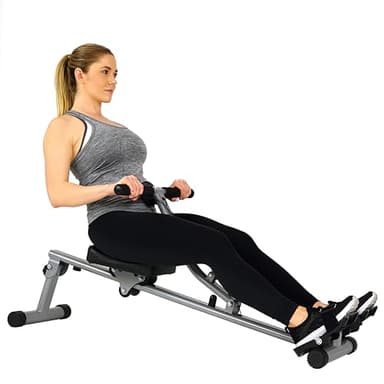
Two cylinders are bolted to the handle arm. When you pull, the pistons push fluid through a narrow valve, and that restriction is the resistance you feel. A dial or a collar changes how far the valve opens, which is how you set the twelve levels the Sunny machines advertise. Nothing spins, nothing stores momentum, and nothing carries the stroke through for you.
That has two consequences worth internalizing before you shop. The first is drift. As the fluid warms across a longer session it thins, the valve passes it more easily, and level eight quietly becomes something closer to level six. It is not a defect in any one machine; it is what a piston does. The second is the shape of the stroke itself. Because there is no flywheel to keep moving on the recovery, the resistance is concentrated in the pull and absent on the return, which is the opposite of how a flywheel rower loads a stroke. You feel it as a movement that resembles rowing rather than one that reproduces it.
What hydraulic gives you in exchange is genuine: near-silent operation, no belt or fan to service, and a mechanism small and light enough to build into a machine you can carry with one hand. Those are real advantages, and they are the reason the category still exists two decades after magnetic became cheap.
Why the cheapest magnetic machine usually wins
This is the part most roundups leave out, so we will lead with it. For the majority of people looking at a hydraulic rower, the better purchase is the cheapest decent magnetic machine instead, and the prices now sit close enough together that the decision is rarely about money.
A magnetic rower moves a magnet toward or away from a metal flywheel. The resistance you set is the resistance you keep, from the first minute to the fortieth — no warming, no drift. It is just as quiet as hydraulic, it needs no more maintenance, and because there is a flywheel carrying momentum, the stroke feels far closer to actual rowing. A budget magnetic machine also tends to publish the specifications that matter, such as a rated weight capacity and a rail length, where hydraulic listings often publish neither.
If your budget can stretch even slightly, the best machines under $200are almost all magnetic, and they will teach you a better stroke and hold their resistance through a real session. Reach for hydraulic when the constraints below genuinely bind — not by default.
When hydraulic is genuinely the right call
There are buyers for whom this is exactly the right category, and the case for them is honest and specific.
The tightest budgets. At around $130, the Sunny SF-RW1205 is the cheapest machine on this site. If the choice is a hydraulic rower now or no rower for another six months, the hydraulic rower is the one you will actually use.
The smallest spaces.These are short machines — the SF-RW1205 is 54 inches long and the compact model 58.1 inches — and the Stamina folds down when you are done with it. In a studio apartment or a shared bedroom, that footprint is the deciding factor.
The lightest thing to move and store. The SF-RW1205 weighs 20.5 lb and the compact model 22.4 lb, which are the two lightest machines we list. You can lift either with one hand and stand it in a closet, and that portability is something no filled water rower and few magnetic machines can match.
The three machines, and how they differ
The two Sunny machines and the Stamina are more different from one another than their shared mechanism suggests.
The Sunny Health & Fitness SF-RW1205is the cheapest and the lightest, at around $130 and 20.5 lb. It carries twelve resistance levels and, more usefully, leveling stabilizers that cheap rowers usually omit — the small feet that stop a light frame rocking on an uneven floor. Its free companion app is included. Sunny does not publish a maximum user weight for it, which is worth noting if you are near a capacity limit.
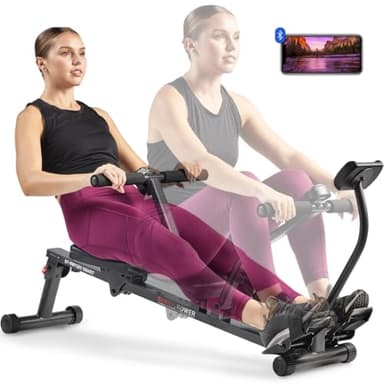
The Sunny Smart Compact Hydraulic Rower, at around $129, adds the thing you are most likely to want at this price: an integrated device holder for the phone or tablet you will inevitably prop in front of you, plus the free SunnyFit app. It is slightly longer and heavier at 58.1 inches and 22.4 lb, still publishes no capacity figure, and it is the model on which Sunny is candid that the cylinders warm and the resistance drifts across a longer session.
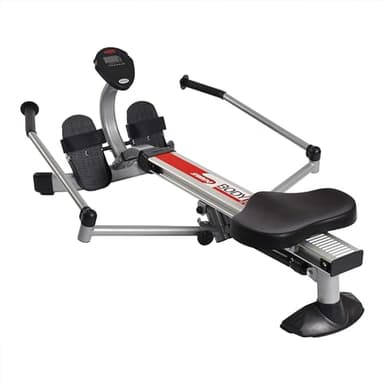
The Stamina Body Trac Glider 1050, at around $175, is the odd one out and the most interesting. Instead of a single strap or handle it uses full-motion arms that swing outward through an arc, much more like a pair of oars, which trains the upper back and shoulders through a wider path than a fixed handle allows. It publishes a 250 lb capacity — the lowest on this site, but at least it is stated — folds for storage, has been sold for roughly two decades, and carries no subscription. At 38 lb it is heavier than the Sunnys but still easy to move.
What you are giving up, and what you are not
Be clear-eyed about the compromises. You are giving up a stroke that transfers to a real rowing machine, a resistance level that holds steady through a long session, and, on two of the three machines, a published weight capacity. Hydraulic monitors report their own arithmetic, so the numbers do not compare with anyone else’s, and there is no parts catalog to keep a machine like this running for a decade.
What you are not giving up is more than the price suggests. Every machine here is quiet, needs no membership, and stores in a space a flywheel rower cannot. For a beginner testing whether the habit will stick, for a small room, or for a genuinely tight budget, that is a fair trade — provided you have read the case for magnetic above and decided the constraints really do apply to you. Our guide to whether cheap rowers are any good takes that question further.