What each one publishes, and what it leaves blank
This is a category where the second function gets the listing space and the numbers get less of it. Put the published figures side by side and the picture changes.
Published maximum user weight, maximum user height, length in use and machine weight for the three two-job machines we track| Machine | Max user weight | Max user height | Length in use | Machine weight |
|---|
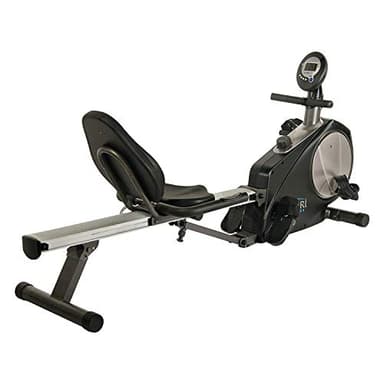
| Avari Conversion II Rower/Recumbent Bike | Not published | Not published | 74.5 in | Not published |
|---|
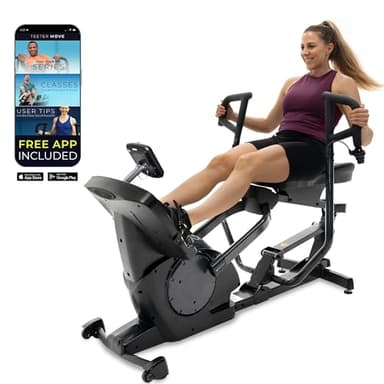
| Teeter Power10 Elliptical Rower | 300 lb | 84 in | 62.8 in | 181.8 lb |
|---|
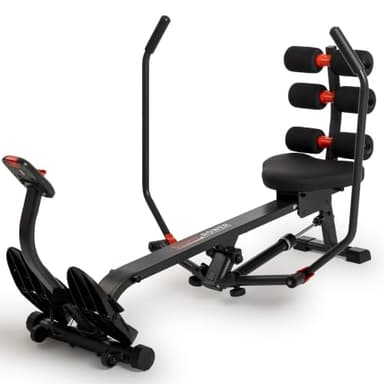
| Sunny Health & Fitness SF-RW525023 2-in-1 Full Motion Rower with Core Trainer | 400 lb | Not published | 56.2 in | Not published |
|---|
The Teeter is the only machine in the registry that publishes a user height range at both ends — 4 ft 8 in to 7 ft 0 in — and it does it in 62.8 inches of floor where a Concept2 needs 96. That is the single most useful published figure on this page, because fitting a 7-foot user and a 4-foot-8 user on the same frame is something no conventional rower claims.
The Avari publishes no maximum user weight at all, which is the one figure a buyer of a convertible frame most often wants, and it publishes no folding or upright storage either: this machine stays where you build it. The Sunny publishes 400 lb and the longest structural warranty of the three. None of them publishes a figure for the second function — no pedal resistance range on the Avari, no stride length on the Teeter — so we print none.
The cost of a second function
It shows up in three places, and they are all worth knowing in advance.
Weight. The Teeter is 181.8 lb and does not come apart. It stores upright on transport wheels, which is the only reason that is tolerable, but it is by a wide margin the heaviest machine on this site. Two-job frames carry the hardware for both jobs all the time.
The stroke. The Teeter’s elliptical path is not a rowing stroke, and Teeter does not claim it is. Nothing you learn on it transfers to an erg test or to a boat. The Avari is a rower with a nylon strap rather than a chain and a flywheel, which is fine for steady cardio and will not teach you a stroke the way a Concept2 does. If a real rowing stroke is the point, best air rowing machines is the honest page.
Warranty. The Avari publishes three years on the frame and 90 days on parts. The Teeter publishes three years structural with one year on mechanical and electrical parts. The Sunny publishes three years structural and 180 days on everything else. Those parts terms are short, and in a machine with two mechanisms there is more to go wrong — how long rowing machines last collects the published terms across the site.
Why someone should still buy one
Three good reasons, and they are not the reasons the listings lead with.
Two people, one room. The Avari is the clearest case here. One household member rows; the other has a knee or a back that does not permit it and pedals with a seatback instead. Buying one frame rather than two machines is not a compromise in that situation, it is the correct answer.
Low-impact work with resistance in both directions. The Teeter loads the push as well as the pull across seven magnetic levels on a 22.7 lb flywheel, which is a fuller-body session than a rower at the same effort, and the Teeter Move app is subscription-free. For someone whose priority is joint-friendly volume rather than a 2k time, that is a real argument, and is a rowing machine low-impact puts it in context.
A supported second exercise. The Sunny’s locking seat and back pad let you work the arms and upper back without the long reach forward that a rowing catch requires. For anyone whose problem is the reach rather than the pull, that second station is the reason to buy the machine, and best rowing machines for arthritis covers the adjacent decisions.
What we would not call a 2-in-1
Plenty of listings use the phrase for things that are not two machines. A device holder is not a second function. An app with cycling classes on it is not a bike. A machine with two handles is a full-motion rower, which is a different thing again and has its own page here. We have kept this list to frames whose maker publishes a genuine second mode of use, which is why there are three machines on it and not ten.