Row & Recover

Station five

Best Rowing Machines for HYROX Training

HYROX runs the row on a Concept2 RowErg, and that single fact decides this page. Here is why the machine you train on changes your race, and what to do if a RowErg is out of reach.

By Stephen V.An enthusiast who reads the manuals and does the math. Not a coach, not a lab.Last verified July 24, 2026.

We earn a commission if you buy through the links on this page, at no cost to you. It has no effect on what we recommend or the order we recommend it in — we say “skip this one” on machines that pay us the same as the ones we like. How we’re funded.

The pick is the Concept2 RowErg, and for once this is not an editorial judgement — it is the machine the race uses. HYROX publishes its format as eight 1 km runs alternating with eight workout stations, and station five is 1,000 m of rowing on the RowErg. If you are training for a race, train on the machine the race scores you on: the drag feels the same, the handle sits the same, and your 1,000 m split on race day means exactly what it meant in your kitchen. Nothing below replaces that. The three alternatives exist for people who already own something else or cannot justify a RowErg, and each one comes with the same caveat stated plainly.

Two details are worth getting right before you train a single metre. First, the row is station five of eight — it lands immediately after the burpee broad jumps and the two sled stations, so you arrive at it with your legs already emptied. A 1,000 m you can hold fresh is not the 1,000 m you will row in a race, which is why practising it cold is close to useless. Second, the SkiErg at station one is the other Concept2 machine in the race, which is why the row and the ski feel related and why Concept2 publishes pacing advice covering both at once.

On pacing, we will quote the one authoritative number rather than invent our own: Concept2 recommends going off your 5,000 m personal-record pace for the 1,000 m RowErg and SkiErg efforts. On damper settings — one of the most-searched HYROX rowing questions there is — neither HYROX nor Concept2 publishes a recommended figure, so we are not going to print one. What we can tell you is how to make your own setting reproducible, which is the drag factor rather than the damper number, and that is explained below.

The short answer

Quick picks

Ranked on published specification, buyer fit and what each machine costs to keep over five years. Select a row to jump to the full write-up. We have not rowed on these machines — here is exactly what we do instead.

#MachineBest forPrice
1
Concept2 RowErg

Concept2 RowErg

The machine every other rowing machine is measured against, and the only one here with no subscription, a 500 lb user limit and a five-year frame warranty at under a thousand dollars.

Best for HYROX — the race machine
2
Assault Fitness AssaultRower Pro

Assault Fitness AssaultRower Pro

A commercial-gym air rower that folds, runs on no electricity at all, and asks nothing of you monthly — built for people who train hard rather than watch classes.

Best alternative air rower
3
MERACH NovaRow R50 Pro

MERACH NovaRow R50 Pro

The closest thing to a Concept2 layout at roughly half the money — 95 inches, a 32-blade fan, ten resistance settings and a frame that splits for vertical storage.

Closest layout for less money
4
YPOO Magnetic Rower

YPOO Magnetic Rower

99 lb of achievable resistance and a 350 lb frame rating at one of the lowest prices here — the numbers are better than the price suggests.

Best budget stand-in

In detail

Every pick, and what is wrong with it

Each machine below gets the same four things: what it does well, what it does not, the five-year cost of owning it, and the case for buying something else instead.

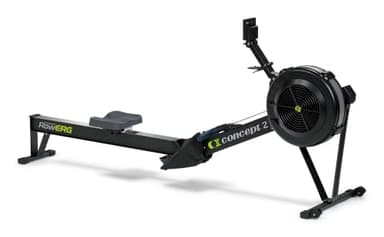
Concept2 RowErg rowing machine

1. Best for HYROX — the race machine

Concept2 RowErg

The machine every other rowing machine is measured against, and the only one here with no subscription, a 500 lb user limit and a five-year frame warranty at under a thousand dollars.

Five years of ownership: $990 — all of it the machine, none of it a subscription. See the full table

Floor space: about 9.0 ft by 4.0 ft once you allow for handle travel and elbow room — roughly 36 sq ft.

What is good

  • 500 lb published user capacity — the highest figure any manufacturer on this page prints
  • No subscription, ever. The PM5 records everything on its own and ErgData is free
  • Separates into two pieces in seconds for storage; front and rear sections stand upright
  • Five-year frame warranty, and a parts supply chain that still serves machines from the 1990s

What is not

  • 96 inches long in use, and Concept2 recommends a 9 ft x 4 ft footprint — it is not an apartment-corner machine
  • Air resistance is the loudest kind. Concept2 publishes no decibel figure and neither do we
  • The 14-inch seat is low; getting up off it is a real consideration if your knees are the reason you are rowing

Skip this one if: Skip it if your floor space is under 9 feet in one direction, or if you share a wall with someone who sleeps early — this is the loud one.

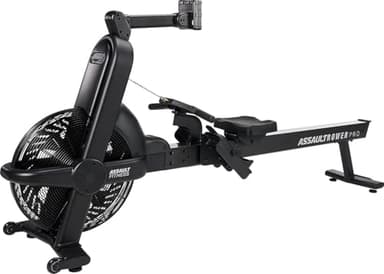
Assault Fitness AssaultRower Pro rowing machine

2. Best alternative air rower

Assault Fitness AssaultRower Pro

A commercial-gym air rower that folds, runs on no electricity at all, and asks nothing of you monthly — built for people who train hard rather than watch classes.

Five years of ownership: $999 — all of it the machine, none of it a subscription. See the full table

Floor space: about 8.7 ft by 3.8 ft once you allow for handle travel and elbow room — roughly 33 sq ft.

What is good

  • Dual stage chain-and-belt drive, built for the abuse of interval work
  • Completely human-powered — no mains socket needed anywhere near it
  • Folds down for storage despite the 109 lb commercial build

What is not

  • 109 lb is a lot of machine to reposition, folding or not
  • The console is functional rather than rich; there is no class library and no app ecosystem
  • Assault publishes no user weight limit on this listing

Skip this one if: Skip it if you want guided workouts on a screen — this machine has no opinion about how you train.

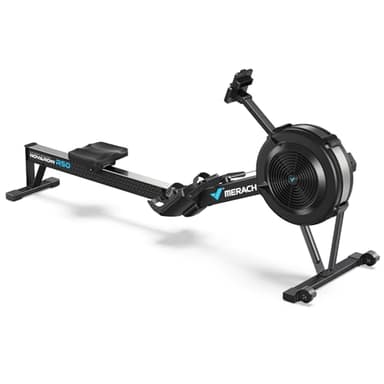
MERACH NovaRow R50 Pro rowing machine

3. Closest layout for less money

MERACH NovaRow R50 Pro

The closest thing to a Concept2 layout at roughly half the money — 95 inches, a 32-blade fan, ten resistance settings and a frame that splits for vertical storage.

Five years of ownership: $560 — all of it the machine, none of it a subscription. See the full table

Floor space: about 8.9 ft by 4.0 ft once you allow for handle travel and elbow room — roughly 36 sq ft.

What is good

  • Full 95-inch competition-style geometry rather than a shortened budget rail
  • Frame separates into two sections and stores vertically
  • Ships 90% pre-assembled with a competition-style monitor and 20+ training modes

What is not

  • MERACH publishes no user weight limit for this model, which matters more on an air rower than most
  • Nothing like Concept2's parts availability if something breaks in year six
  • At 95 inches it needs the same floor as the machine it is undercutting

Skip this one if: Skip it if you were buying an air rower specifically for Concept2's decades-long parts support — that is the thing the discount is buying you out of.

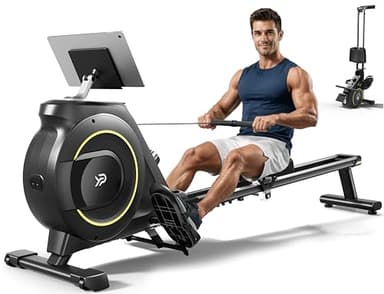
YPOO Magnetic Rower rowing machine

4. Best budget stand-in

YPOO Magnetic Rower

99 lb of achievable resistance and a 350 lb frame rating at one of the lowest prices here — the numbers are better than the price suggests.

Five years of ownership: $200 — all of it the machine, none of it a subscription. See the full table

Floor space: about 6.4 ft by 3.5 ft once you allow for handle travel and elbow room — roughly 22 sq ft.

What is good

  • 99 lb of achievable resistance across 16 levels, well beyond typical budget magnetic machines
  • 350 lb published capacity on a heavy-duty steel frame
  • 46-inch dual rail at 65 inches overall — compact for the stroke length it gives

What is not

  • YPOO does not publish a machine weight
  • A less established brand than Sunny or MERACH if you need parts in three years
  • The LCD is basic

Skip this one if: Skip it if long-term parts support matters more to you than the spec sheet — that is the trade here.

How to choose

What actually decides this

Four things decide a HYROX rowing machine, and only one of them is about the machine being nice. Here is what the makers publish about the four picks.

Published resistance type, overall length, monitor and mains-power requirement for the four picks on this page
MachineResistanceLengthMonitorNeeds mains power
Concept2 RowErgair96 inPM5, Bluetooth + ANT+No
Assault Fitness AssaultRower Proair92 inAssault consoleNo
MERACH NovaRow R50 Proair95 inMERACH competition monitor, BluetoothNo
YPOO Magnetic Rowermagnetic65 inLCD, app compatibleNo

Does your number transfer? This is the whole page in one question. A 1,000 m split on a Concept2 is a figure hundreds of thousands of people can compare directly, because the machines are calibrated to behave alike and every HYROX venue uses the same model. A 1,000 m on a MERACH or a YPOO is a perfectly real piece of work and an uncomparable number — different fan, different calibration, different monitor maths. If your goal is a target race time, that gap matters more than any feature on the spec sheet. It is the same argument we make for on-water rowers doing erg tests.

Air resistance, because the race is air. All four picks here are air machines except the YPOO, which is magnetic and is included for exactly one reason: it publishes 99 lb of achievable resistance, which is enough top end to train hard on when a typical budget magnetic rower runs out. On a magnetic brake the resistance is set before you start, so a flat-out effort feels capped; on air it climbs with every extra watt you put in, which is what a race finish actually feels like. The full explanation is in resistance explained.

A frame that survives interval training. HYROX preparation is almost entirely intervals and compromised-state work, which is the exact load that breaks cheap rowers — sudden, repeated, and done while you are too tired to be smooth. The AssaultRower Pro is the strongest answer after the RowErg: a dual-stage chain-and-belt drive built for interval abuse at a commercial-grade 109 lb, no mains socket, nothing to pay monthly. Its honest costs are a basic console and 109 lb of machine to reposition. The CrossFit roundup overlaps heavily here for the same reason.

Setting the drag so your sessions repeat. Since no official source publishes a HYROX damper recommendation, the practical approach is to stop thinking about the damper lever and use the drag factor the PM5 reports, because the same damper number gives different drag on a dusty flywheel in a warm room than it did last month. Pick a drag factor you can hold 1,000 m at, write it down, and set it every session. That way the only variable between training and race day is you. Our damper setting guide and drag factor guide cover how to read and reproduce it, and the 500 m split explainer covers the pace figure Concept2’s 5 km-PR advice is expressed in.

How to actually train the station. Two sessions do most of the work. First, repeated 1,000 m efforts at your target pace with short recoveries, so the distance stops feeling long — our interval session is a template. Second, and more important, the row done after something that has already tired your legs, because that is the only honest rehearsal of station five. Rowing cold and rowing on empty legs are different skills, and the second one is the one being tested. For general conditioning between those, steady state does the aerobic base work, and the 5 km session is the exact distance Concept2’s pacing advice is anchored to.

One thing this page will not do is tell you a race time you should be aiming for. HYROX publishes finish times by division and those are real; the rowing split inside them is not something we can verify per athlete, so we are not going to publish a target dressed up as a standard. Row your own 1,000 m fresh, row it again on tired legs, and train the difference — that gap is the only number that tells you anything.

Straight answers

Questions people actually ask

What rowing machine does HYROX use?

The Concept2 RowErg. HYROX publishes station five of its eight-station format as 1,000 m of rowing on the RowErg, and the SkiErg at station one is the other Concept2 machine in the race. Training on the same machine means your split numbers transfer directly to race day.

How far is the HYROX row?

1,000 m, and it is station five of eight - immediately after the burpee broad jumps and the two sled stations. The full published format is eight 1 km runs alternating with the eight stations: SkiErg 1,000 m, sled push 50 m, sled pull 50 m, burpee broad jump 80 m, row 1,000 m, farmers carry 200 m, sandbag lunges 100 m, and 100 wall balls.

What damper setting should I use for the HYROX row?

Neither HYROX nor Concept2 publishes a recommended damper setting, so we are not going to print one. The useful approach is to ignore the damper number and set the drag factor the monitor reports, because the same damper position gives different drag as a flywheel collects dust. Pick a drag factor you can hold for 1,000 m, record it, and use it every session.

What pace should I row the HYROX 1,000 m at?

Concept2's own published guidance is to go off your 5,000 m personal-record pace for the 1,000 m RowErg and SkiErg efforts. That is the one authoritative figure we will quote. Because the row lands at station five on already-tired legs, test that pace after hard leg work rather than fresh.

Can I train for HYROX on a cheaper rowing machine?

You can train the fitness, but not the number. A 1,000 m on a MERACH or YPOO is real work on a machine calibrated differently from the race RowErg, so the split will not compare. If you are chasing a target finish time, that gap matters. If you are building general capacity and will do your race-pace work at a gym with a RowErg, a cheaper air rower at home is a sensible compromise.

The honest part

What we did not do

We have not rowed on these machines. We do not own them, there is no test lab here, and nobody writing this holds a coaching certification. Every ranking on this page is an argument from published specification and buyer fit, not from a stopwatch.

What we did do is read each manufacturer’s own published figures, record the ones they decline to publish, compute the floor space and the five-year cost, and date all of it. The full method is here so you can check our working or disagree with it.

Show your working

Sources

Keep going

Read next