Row & Recover

Folds away

Best Foldable Rowing Machines

Every machine here folds, but folding means three different things — and only one maker publishes both the in-use and the folded dimensions.

By Stephen V.An enthusiast who reads the manuals and does the math. Not a coach, not a lab.Last verified July 24, 2026.

We earn a commission if you buy through the links on this page, at no cost to you. It has no effect on what we recommend or the order we recommend it in — we say “skip this one” on machines that pay us the same as the ones we like. How we’re funded.

“Foldable” is the most abused word in a rowing machine listing. Almost every machine claims it, and it means three genuinely different things depending on the frame.

Some machines hinge in the middle so the rail swings up toward the flywheel. Some fold the tank or the resistance unit down over the rail. Some, like the Stamina Body Trac, collapse the whole apparatus flat because they were barely a rowing machine to begin with. Each trades a different dimension: one saves length and adds height, another saves footprint but not weight, a third saves everything because there was little there in the first place.

So the question that actually matters is not whether a machine folds, but what its folded dimensions are — and here almost nobody helps you. Circuit Fitness is the rare exception on this page: it publishes both the in-use footprint (91 by 20.5 by 31.5 inches) and the folded one (49 by 20.5 by 51 inches), which lets you see the trade in full. It saves you about three and a half feet of length and costs you about a foot and a half of height. Most makers publish one number and leave you to guess the other.

The second question is weight. A machine that folds is only foldable in practice if you can lift the part that moves. And the third is the one people forget entirely: a folded machine still has to go somewhere. You are not making it disappear. You are trading floor for a corner.

Keep one more thing in mind as you read: folding is a convenience, not a category of machine. A folding rower is still an air, water, magnetic or hydraulic rower first, and all the usual trade-offs — noise, stroke feel, resistance ceiling, published capacity — still apply. The fold is a feature layered on top. So the right way to use this page is to pick the machine you would want anyway, then treat its folded dimensions and its folding weight as the tie-breakers, rather than choosing a worse machine because it collapses a little smaller.

The short answer

Quick picks

Ranked on published specification, buyer fit and what each machine costs to keep over five years. Select a row to jump to the full write-up. We have not rowed on these machines — here is exactly what we do instead.

#MachineBest forPrice
1
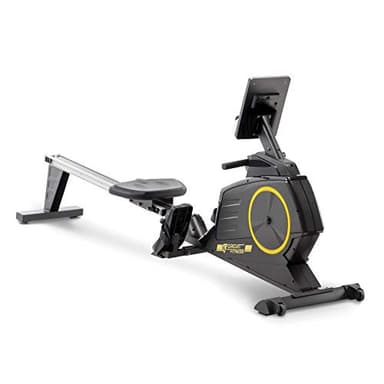
Circuit Fitness Deluxe Foldable Magnetic Rower

Circuit Fitness Deluxe Foldable Magnetic Rower

A 20 lb flywheel and belt drive on a machine that folds from 91 inches down to 49 — the largest length reduction of anything here.

Biggest fold
2
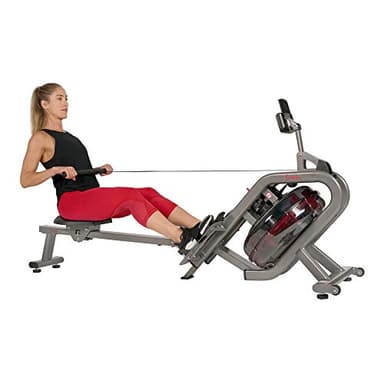
Sunny Health & Fitness Phantom Hydro

Sunny Health & Fitness Phantom Hydro

A vertical-tank water rower that folds — one of very few machines that gives you the water feel and still tucks away, with a published 300 lb limit.

Best foldable water
3
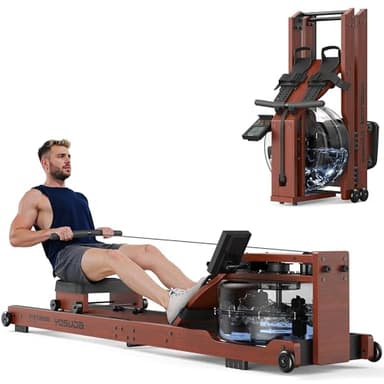
YOSUDA Foldable Wooden Water Rower

YOSUDA Foldable Wooden Water Rower

Beech wood, a 22-liter tank, a 400 lb capacity and a 180-degree fold — the most capable machine here for anyone who wants a wooden rower in a flat.

Best folding wood
4
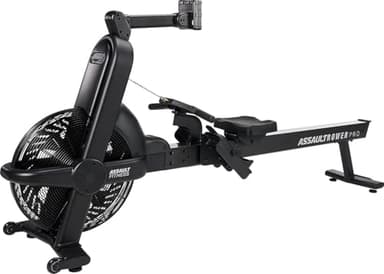
Assault Fitness AssaultRower Pro

Assault Fitness AssaultRower Pro

A commercial-gym air rower that folds, runs on no electricity at all, and asks nothing of you monthly — built for people who train hard rather than watch classes.

Best folding air
5
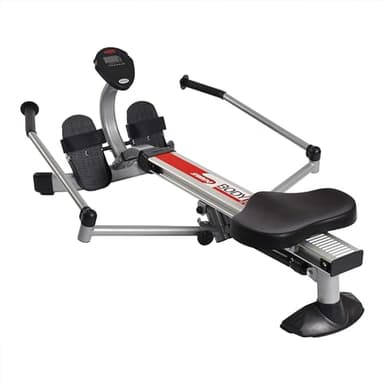
Stamina Body Trac Glider 1050

Stamina Body Trac Glider 1050

Full-motion rowing arms that swing outward like oars, 38 lb, 250 lb capacity — an honest budget machine that has been sold for two decades.

Smallest folded

In detail

Every pick, and what is wrong with it

Each machine below gets the same four things: what it does well, what it does not, the five-year cost of owning it, and the case for buying something else instead.

Circuit Fitness Deluxe Foldable Magnetic Rower rowing machine

1. Biggest fold

Circuit Fitness Deluxe Foldable Magnetic Rower

A 20 lb flywheel and belt drive on a machine that folds from 91 inches down to 49 — the largest length reduction of anything here.

Floor space: about 8.6 ft by 3.7 ft once you allow for handle travel and elbow room — roughly 32 sq ft.

What is good

  • Folds from 91 x 20.5 x 31.5 in to 49 x 20.5 x 51 in — Circuit Fitness publishes both figures
  • 20 lb flywheel with two-way bearing belt transmission gives a smoother stroke than most budget magnetics
  • 300 lb published weight capacity

What is not

  • 90 lb, which is heavy for something you intend to fold twice a day
  • Folded it becomes 51 inches tall — you gain floor, you lose a corner
  • 8 resistance settings only

Skip this one if: Skip it if you will have to carry it up stairs — 90 lb of folding machine is still 90 lb.

Sunny Health & Fitness Phantom Hydro rowing machine

2. Best foldable water

Sunny Health & Fitness Phantom Hydro

A vertical-tank water rower that folds — one of very few machines that gives you the water feel and still tucks away, with a published 300 lb limit.

Floor space: about 7.8 ft by 3.8 ft once you allow for handle travel and elbow room — roughly 29 sq ft.

What is good

  • Actually folds, which almost no water rower does
  • 300 lb published user capacity, stated plainly on the listing
  • Swiveling monitor tracks 500m splits, so you can train against a number

What is not

  • 39.5 inches tall in use — the vertical tank is what makes the folding work and it is not subtle
  • 88 lb dry
  • 300 lb is a real ceiling if you are near it

Skip this one if: Skip it if you weigh close to 300 lb — buy the headroom instead, this one publishes its limit for a reason.

YOSUDA Foldable Wooden Water Rower rowing machine

3. Best folding wood

YOSUDA Foldable Wooden Water Rower

Beech wood, a 22-liter tank, a 400 lb capacity and a 180-degree fold — the most capable machine here for anyone who wants a wooden rower in a flat.

Floor space: about 7.2 ft by 3.3 ft once you allow for handle travel and elbow room — roughly 24 sq ft.

What is good

  • 400 lb published capacity and users up to 6 ft 6 in, both stated on the listing
  • Folds 180 degrees and rolls, so the stored footprint is genuinely small
  • 30 mm FSC-certified beech, not veneer over particle board

What is not

  • 55 lb is light for a wooden rower, which is a comment on the frame as much as a convenience
  • The dedicated monitor is basic next to an S4 or a PM5
  • 1-year parts warranty

Skip this one if: Skip it if you want the WaterRower's heft and finish — this is a different price and it shows in the hardware.

Assault Fitness AssaultRower Pro rowing machine

4. Best folding air

Assault Fitness AssaultRower Pro

A commercial-gym air rower that folds, runs on no electricity at all, and asks nothing of you monthly — built for people who train hard rather than watch classes.

Floor space: about 8.7 ft by 3.8 ft once you allow for handle travel and elbow room — roughly 33 sq ft.

What is good

  • Dual stage chain-and-belt drive, built for the abuse of interval work
  • Completely human-powered — no mains socket needed anywhere near it
  • Folds down for storage despite the 109 lb commercial build

What is not

  • 109 lb is a lot of machine to reposition, folding or not
  • The console is functional rather than rich; there is no class library and no app ecosystem
  • Assault publishes no user weight limit on this listing

Skip this one if: Skip it if you want guided workouts on a screen — this machine has no opinion about how you train.

Stamina Body Trac Glider 1050 rowing machine

5. Smallest folded

Stamina Body Trac Glider 1050

Full-motion rowing arms that swing outward like oars, 38 lb, 250 lb capacity — an honest budget machine that has been sold for two decades.

What is good

  • The arms swing through an arc rather than pulling a single strap, which better resembles sculling
  • 38 lb and folds — genuinely storable in a cupboard
  • 250 lb published capacity, stated on the listing

What is not

  • 250 lb is the lowest capacity on this site
  • Hydraulic cylinders, with the same warm-up drift as any hydraulic machine
  • Stamina does not publish assembled dimensions in a usable form on this listing, so we do not print any

Skip this one if: Skip it if you are over about 200 lb — you will be close enough to the published ceiling to worry about it.

How to choose

What actually decides this

Folding is three different tricks

The magnetic and hydraulic machines here hinge the rail upward. Circuit Fitness’s deluxe model is the clearest example: its 91-inch in-use length folds down to 49 inches, but its 31.5-inch height rises to 51 inches. You reclaim length, which is usually the binding constraint in a small room, and you pay for it in a taller object that needs headroom in whatever cupboard or corner it lives in.

The water rowers fold differently. The Sunny Phantom Hydro stands its tank vertical and folds; the YOSUDA wooden machine folds 180 degrees at the hinge and rolls away on built-in wheels. And the Stamina Body Trac is the outlier — its full-motion arms and short frame collapse nearly flat, which is why it stores smaller than anything else here despite being a much simpler machine.

The number only Circuit Fitness publishes

We went looking for folded dimensions across every machine on this site. Circuit Fitness is the one that prints both states plainly. That matters, because the folded figure is the one you are actually buying when you buy for storage, and a maker that publishes it has thought about where the machine goes when you are done. A maker that publishes only the in-use length is selling you the easy half of the story.

Where a folded dimension is not published, we say so rather than estimate it. The Assault folds and the Sunny and YOSUDA machines fold, but the exact folded envelope is not stated for all of them, so treat the fold as a real feature and the specific stored size as something to confirm before you commit a particular corner to it.

The weight you have to lift

A fold is only useful if you will actually do it, and that comes down to what you have to move. The YOSUDA wooden water rower is 55 lb and rolls, which is about as friendly as folding gets. Circuit Fitness’s machine is 90 lb, the Sunny Phantom Hydro 88 lb, and the AssaultRower Pro 109 lb of commercial frame — that last one folds, but folding 109 lb is a decision, not a habit.

Be honest with yourself about this before you buy. A machine you fold once and never again is just a heavy machine that takes up the same floor as one that does not pretend to fold at all. If you intend to fold daily, weight is the specification to sort on, and the lighter frames earn their place for exactly that reason.

Water and air fold too

Folding is not only a budget-magnetic feature. The Sunny Phantom Hydro gives you a genuine water stroke — a self-regulating whoosh and a swivel monitor with 500m splits — in a frame that stands its tank vertical and folds, with a published 300 lb capacity. The YOSUDA is a 30 mm FSC-certified beech machine with a 22-liter tank and a published 400 lb capacity and 6 ft 6 in fit, and it still folds flat and rolls.

The AssaultRower Pro is the air option, and it is the only one here that folds a full-length competition-style air frame. It asks nothing of you monthly, runs on no electricity, and is built for hard intervals. What it does not publish is a user weight capacity, so that is the gap to weigh against its build.

The honest limit of folding

Folding solves storage. It does not solve the floor you need while you are rowing — that is set by the in-use length, not the folded one, and it does not change because the machine can hinge. If your problem is that you cannot leave a machine out, folding is the answer. If your problem is that you cannot clear enough floor to row in the first place, a genuinely compact machine is the better page, because it is short in use rather than short in the cupboard.

And wherever the machine folds to, remember it still occupies that space. A folded rower against a wall is a tall narrow object you walk around. The apartment roundup measures both the rowing floor and the stored footprint together, which is the way to think about a small home.

Match the mechanism first, then the fold

Because these machines fold in different ways for different reasons, the mechanism is still the first decision. If you want a self-regulating stroke with a resistance ceiling you cannot easily reach, the AssaultRower Pro is the folding air option, at the cost of being the heaviest thing here to move. If you want a low-frequency whoosh and a machine that doubles as something pleasant to have in a room, the two water rowers fold and one of them is wooden. If you want silent, consistent, plug-nothing-in resistance, a folding magnetic frame like the Circuit Fitness is the quiet choice.

The Stamina sits outside that framing on purpose. It is a hydraulic, oar-style machine rather than a full-rail rower, which is exactly why it folds so small and weighs so little. It is the pick when the smallest possible stored size matters more than a true rowing stroke, and it is honest about being that trade rather than pretending otherwise.

The corner is part of the cost

A folded machine has to live somewhere, and that somewhere is rarely free. A rail hinged upright needs headroom; a machine that folds flat needs a gap under a bed or behind a sofa; a heavy folder needs to be near where you use it because you will not carry it far. The people who are happiest with a folding rower are the ones who chose the corner before they chose the machine, and then bought the frame whose folded shape actually fits it.

It is also worth being honest that a machine folded away is a machine slightly less likely to be used, because setting it up is one more small barrier between you and a session. If you have the floor to leave a rower out, a machine that does not fold at all is often the better buy. Folding earns its place when leaving the machine out is genuinely not an option — not as a default.

Straight answers

Questions people actually ask

Do foldable rowing machines actually save space?

They save storage space, not rowing space. Folding reclaims floor when the machine is not in use - Circuit Fitness's deluxe model folds from 91 inches long down to 49 - but it does nothing for the floor you need while you row, which is set by the in-use length. If your constraint is clearing enough room to row at all, a compact machine that is short in use will serve you better than a long machine that folds.

Which rowing machine folds up the smallest?

The Stamina Body Trac Glider 1050, because its full-motion arms and short frame collapse nearly flat and it weighs only 38 lb. The trade is that it is a hydraulic, oar-style machine rather than a full-rail rower, so it stores smaller precisely because there is less machine there. Among true rail rowers, Circuit Fitness publishes the clearest folded figure at 49 by 20.5 by 51 inches.

How much do foldable rowing machines weigh?

It ranges widely here, and the weight is what determines whether you will actually fold it. The YOSUDA wooden water rower is 55 lb and rolls; Circuit Fitness's machine is 90 lb; the Sunny Phantom Hydro is 88 lb; the AssaultRower Pro is 109 lb. A machine you have to wrestle will get folded once and then left out, so if you plan to fold daily, sort on weight before anything else.

Can you fold a water rowing machine?

Yes. The Sunny Phantom Hydro stands its tank vertical and folds, and the YOSUDA wooden rower folds 180 degrees at the hinge and rolls away on wheels. Both keep a genuine water stroke - the self-regulating whoosh and, on the Sunny, a swivel monitor with 500m splits. Folding is not limited to budget magnetic machines, though the water frames tend to be heavier to move.

Do folding rowing machines still need to be stored somewhere?

Yes, and it is the step people forget. Folding does not make a machine disappear - it converts a long low object into a shorter, taller one that still occupies a corner and often needs headroom. A folded rower against a wall is something you walk around. Plan the corner before you buy, and check the folded height against wherever you intend to keep it.

Is it worth buying a foldable rowing machine?

It is worth it when leaving a machine out is genuinely not an option - a shared room, a tight apartment, a space that has to do double duty. In that situation a fold is the difference between owning a rower and not. If you have the floor to leave one out, a non-folding machine is often the better buy, because folding adds weight, cost and one more small barrier between you and a session. Choose the fold for a real constraint, not as a default.

The honest part

What we did not do

We have not rowed on these machines. We do not own them, there is no test lab here, and nobody writing this holds a coaching certification. Every ranking on this page is an argument from published specification and buyer fit, not from a stopwatch.

What we did do is read each manufacturer’s own published figures, record the ones they decline to publish, compute the floor space and the five-year cost, and date all of it. The full method is here so you can check our working or disagree with it.

Show your working

Sources

Keep going

Read next