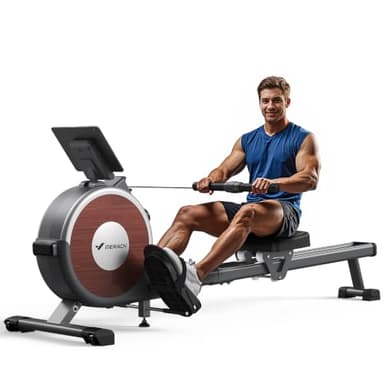
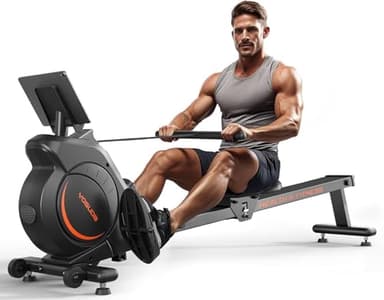
Four criteria, in the order they should decide your shortlist. Here is what the makers publish about the six picks.
Published seat height, resistance type, user weight capacity and machine weight for the six picks on this page| Machine | Seat height | Resistance | Capacity | Machine weight |
|---|
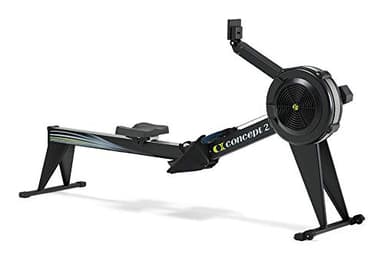
| Concept2 RowErg with Tall Legs | 20 in | air | 500 lb | 68 lb |
|---|
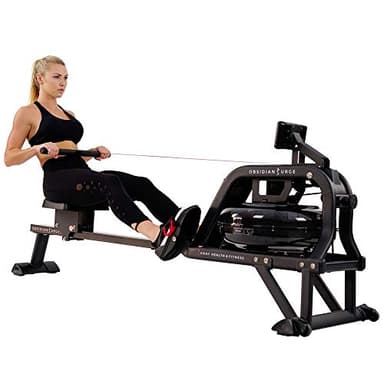
| Sunny Health & Fitness Obsidian Surge | 17 in | water | Not published | 82 lb |
|---|
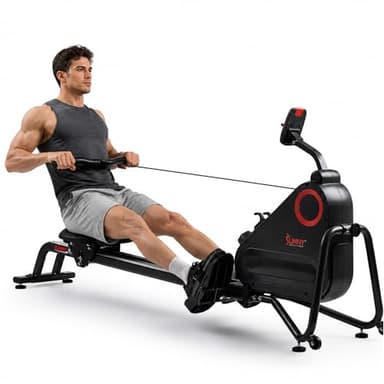
| Sunny Health & Fitness Smart Dual-Rail Rower | Not published | magnetic | 300 lb | 68 lb |
|---|
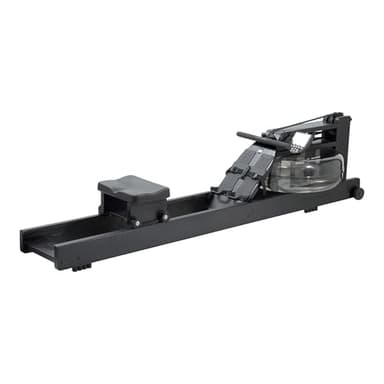
| WaterRower Natural (Ash) | Not published | water | Not published | 103.5 lb |
|---|
| MERACH Q1S | Not published | magnetic | 350 lb | 58.9 lb |
|---|
| YOSUDA Magnetic Rower | Not published | magnetic | Not published | 43 lb |
|---|
1. Seat height, because transfer is the real barrier. Rowing itself is seated, low-impact and takes your bodyweight off your knees and ankles entirely — which is why it comes up at all in this context. The hard part is the two seconds at each end of the session. A 14-inch seat means dropping to roughly the height of a footstool and then pushing back up through your knees and wrists, which is precisely the movement that sore joints object to. Twenty inches turns it into standing up from a chair. If you take one thing from this page, take that the specification to hunt for is the one most listings omit.
2. Resistance that is light at the start of the pull. An air rower builds resistance from how hard you pull, so the first inch of the stroke is light and it loads up as the handle moves — comfortable at an easy pace, and the reason the damper lever is less important than people think ( damper setting explained covers why). A magnetic rower sets a fixed level, so the force is the same from the first inch to the last, and a low level is genuinely low. Water sits between the two and is the smoothest of the three to most people. Hydraulic machines are the ones to avoid here: the cylinders are stiff from the first inch and the arms move independently, which asks more of shoulders and wrists, not less.
3. A rail you are not cramped on. A short rail forces a tighter knee angle at the catch, and a tighter knee angle is where knee complaints usually start. Only three machines we cover publish a rail length at all — Sunny’s dual-rail at 50 inches, its extra-long-rail model at 48 and the YPOO at 46 — so for everything else the overall machine length is the only proxy, and rail length explains how far that proxy can be trusted. The Sunny Smart Dual-Rail is on this list largely because it publishes the number.
4. The weight of the machine, not just the rower. A 103 lb WaterRower that stands on end in a living room is fine if it never has to move. A 43 lb YOSUDA can be walked to a different wall by one person with sore hands, which is a different kind of freedom. Published machine weights in the table above range from 43 lb to 103.5 lb across six machines, and that spread is worth as much thought as the price. How to store a rowing machine goes through what upright storage actually asks of you.
What rowing does and does not change
What a rowing machine offers here is a full-body cardio session with no impact and no bodyweight through the joints, at an intensity you set yourself with your own hands — you can row for twenty minutes at an effort that never once asks a joint for a hard pull. Is rowing low impact goes through the mechanics, and is a rowing machine good for arthritis is the longer-form version of this question with the equipment stripped out.
What it does not do is treat anything, and we are not going to imply otherwise. There is no machine on this page that is good for a joint; there are machines that are easier to get on and off, and that is the whole of our claim. Two practical notes that cost nothing: the handle wants a relaxed hook rather than a tight fist, which hand care covers in detail, and the foot straps want to sit across the ball of the foot rather than the instep, which foot strap setup covers. Both take load off the small joints that notice it most.
The machines we left off, and why
Every hydraulic rower in our registry is absent from this list on purpose — stiff cylinders from the first inch and independent arms are the wrong combination here, however cheap the machine is, and best hydraulic rowing machines is honest about what they are for instead. The connected machines are absent for a different reason: they are good machines, but they publish no seat height, they need a mains socket, and a $39 to $50 monthly membership is a poor fit for someone whose main requirement is a machine they can use on the days their joints allow it. If guided sessions are what you want, the connected roundup has them.
How to choose in one paragraph
If the seat height is your constraint and the budget allows it, buy the Concept2 RowErg with tall legs — a published 20-inch seat, a published 500 lb capacity, no subscription and a five-year frame warranty, on the only machine here whose parts you will still be able to buy in a decade. If that is too much money, the Sunny Obsidian Surge publishes 17 inches and a water stroke for a fraction of it. If you want the quietest, most predictable pull in a shared home, the Sunny Smart Dual-Rail publishes both a 50-inch rail and a 300 lb capacity. If you are spending under two hundred dollars, the MERACH Q1S is the budget machine that actually publishes its limits. And if the machine will have to be moved by one person, the 43 lb YOSUDA is the one that can be.
Related pages worth a look: best rowing machines for seniors runs the same seat-height argument for a different reader, and best rowing machines for bad knees narrows it to the joint people ask about most.