What the water actually does
The resistance rises with the square of paddle speed, roughly — the same relationship that governs a fan. In practice that means the stroke feels heavy at the catch and lightens as you accelerate the handle, which is closer to the feel of a boat than a magnet-and-flywheel arrangement gets.
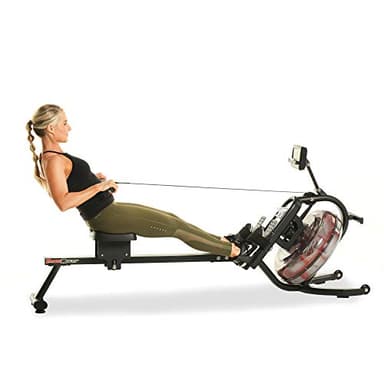
You adjust it, if at all, by changing the volume of water in the tank. Most machines ship with a recommended level and most owners never change it. The Fitness Reality 3000WR is the exception on this page: it publishes six fillable levels and includes the pump, which makes resistance a decision rather than a fixed property of the machine.
Wood or steel?
Both exist, and they are genuinely different purchases.
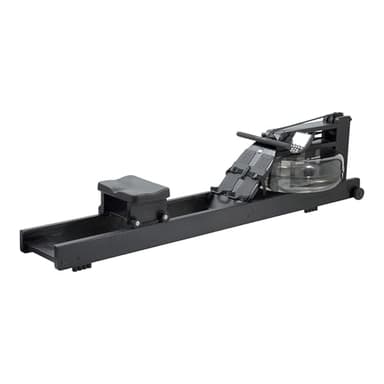
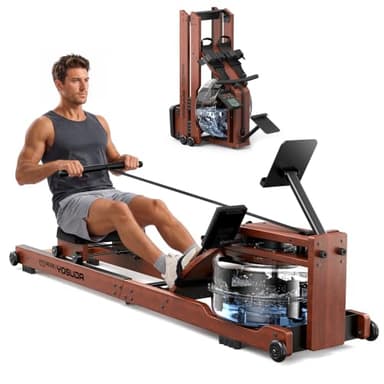
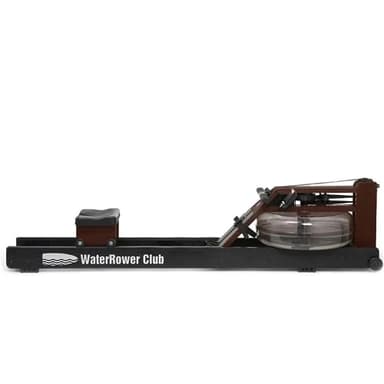
Wood— WaterRower’s ash and oak machines, YOSUDA’s 30 mm FSC-certified beech — damps vibration in a way steel does not, and looks like an object rather than equipment. WaterRower builds in Rhode Island from sustainably sourced timber and has done since the mid-1980s.
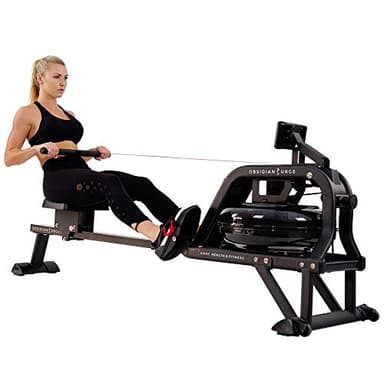
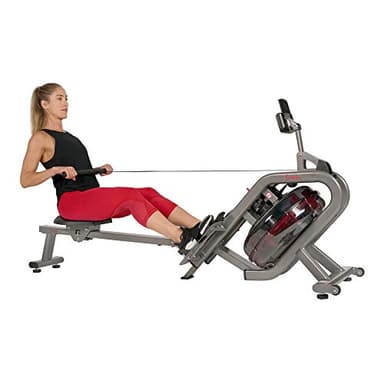
Steel— Sunny’s Obsidian Surge and Phantom Hydro — costs a quarter as much and does the same mechanical job. What it does not do is look like furniture, and if the reason you are on this page is that a rowing machine has to live in your living room, that is the whole point.
The number WaterRower does not publish
WaterRower does not state a maximum user weight on its Amazon listings for the Natural or the Club. Sunny publishes 300 lb for the Phantom Hydro. YOSUDA publishes 400 lb and a 6 ft 6 in maximum user height for its wooden machine. MERACH publishes 400 lb. Fitness Reality publishes 300 lb.
We are not going to tell you what WaterRower’s limit is, because we do not know and no published figure exists on the source we read. If you are near any reasonable ceiling, that omission is worth an email to WaterRower before you spend $1,700 — and it is exactly the sort of gap this site exists to point at rather than paper over.
Storage: the actual advantage
A WaterRower stands on its front end and takes up roughly 22 by 20 inches of floor. That is about two square feet — the footprint of a floor lamp — and it is the single most compelling practical argument for the type.
Two caveats. It is 103.5 lb filled, so standing it up is a deliberate two-handed act rather than something you do absent-mindedly. And it wants a wall, because a seven-foot wooden object standing free in a room is a hazard.
The folding water rowers — YOSUDA’s 180-degree fold at 55 lb, Sunny’s Phantom Hydro — are the answer if you need to move the machine regularly rather than park it.
Running costs nobody mentions
Water rowers need water, and water needs looking after. Tanks are treated with purification tablets a few times a year to stop algae, and the level needs topping up occasionally. It is a small cost and a small chore, but it is not zero, and it is the one ongoing obligation an air or magnetic machine does not have.
Against that: no water rower on this page except the Ergatta carries a subscription. Over five years that is worth far more than a few tablets.
A note on the Ergatta
The Ergatta is a WaterRower with a screen and a games layer, sold direct only. It is not available on Amazon, so there is no live price for it here and no buy button — we are not going to write a recommendation whose button cannot exist. Ergatta publishes $39 a month, falling to $27 if you prepay five years at $1,620.
If the games are the draw, it is a real product and it works. If they are not, you can buy the WaterRower underneath it for considerably less.
If you have not yet settled water against the mechanism most buyers compare it with, the head-to-head is at water vs air rowing machine — and the short version is that neither wins on the stroke, because both push back harder the harder you pull.
Two water rowers have joined the site since this page was last ranked, and both are worth a look before you commit. XTERRA’s ERG750Wpublishes six knob-set resistance levels on top of its 15-liter tank — the only water rower here whose load you can change without moving water — and the only multi-year frame warranty any water rower on this site publishes, against no stated weight capacity at all. The JOROTO MR280PRO goes the other way: an FSC-certified oak frame that folds 180 degrees to vertical, with a published 400 lb capacity and a 39-inch maximum leg length, which is a more precise fit check than the height ceilings most makers print.